"Previously On..."
A recurring look at recent TV I've watched, notable industry news, items from my archive & their significance, and the history of TV programming as told through the pages of TV Guide or Variety.


Stranger Things (Netflix): I am not going to spoil anything but while it had its entertaining moments, the series finale was too long and the final 45 minutes were quite dull. Maybe bigger fans of the series overall will like it more, but I am glad this show is over so I don’t have to keep watching it.
King Of Collectibles (Netflix): As a passionate collector I want to like all series about collecting but the latest season of this follow doc about Ken Goldin at Goldin Auctions is insufferable. I kind of liked S1 and S2 but Ken has become more and more annoying and arrogant but also a worse performer on camera over time. Contrast this program with Pawn Stars, a show I adore. Both feature scenes and stories that are clearly staged or recreated but Rick’s charm and style make Pawn Stars fun and allows for the suspension of disbelief. In King of Collectibles on the other hand, every scene feels so phony because of Goldin’s poor acting skills and because the rest of the cast overreact to every item they find. Thumbs down.
Emily In Paris/Rome (Netflix): S5 of the romcom remains highly entertaining despite becoming very formulaic. In each episode Emily solves a business challenge while juggling some sort of love triangle and dealing with her French bosses/colleagues both mocking and supporting her. The move to Rome is welcome but doesn’t really change that much, but it doesn’t really need to.
Vanderpump Rules (Bravo): I was as sucked into the orignal VPR as much as anyone but have given up on the new cast early on as I have found them and the episodes quite dull. If I hear that it becomes juicy I will return.
Foyle’s War and Midsomer Murders (Acorn) I’ve heard of both of these long-running British mysteries for quite some time but never tried them until now. Foyle’s War is set in the UK during WWII and lasted 8 seasons over 13 years (2002-2015) but that is only 28 episodes. Midsomer Murders began in 1997 and is still running after 25 TV seasons. Both are small town mystery series where a lead older detective solves a complicated crime with the help of a young sidekick. Sometimes the crimes can be a bit grisly. I am only a few episode into both shows but so far I like Foyle’s War more as it stays focused on the crime-solving.

These are my latest and perhaps the most important & meaningful television items that I have ever acquired. They are Gene Roddenberry’s personal copies of the scripts for both Star Trek pilots with extensive hand annotations.
There were two pilots for the original Star Trek, a show that has a deep emotional connection for me given how many times I have watched it since I was six.
The first was called The Cage and starred Jeffrey Hunter as Capt. Christopher Pike, the same character played by Anson Mount now on Star Trek: Strange New Worlds. This was rejected by NBC but it liked the concept and ordered a new pilot that Hunter did not want to do so William Shatner was cast as Capt. Kirk in Where No Man Has Gone Before. The footage from The Cage was reused in the S1 episode of Star Trek called The Menagerie.
These scripts are remarkable as they are early drafts and perhaps the closest to Roddenberry’s thought process in creating Star Trek that a private collector can own based on what has come up at auction.
The Cage script is so early that the Captain’s name is still Robert April which was an early consideration before Pike. Where No Man Has Gone Before was written by Samuel Peebles but these are Roddenberry’s edits.
The photographs below illustrate the level of Roddenberry’s annotations.
The Cage, “Rough Draft, Work Copy” 9-3-64


Where No Man Has Gone Before, Second Draft, 6/16/65.


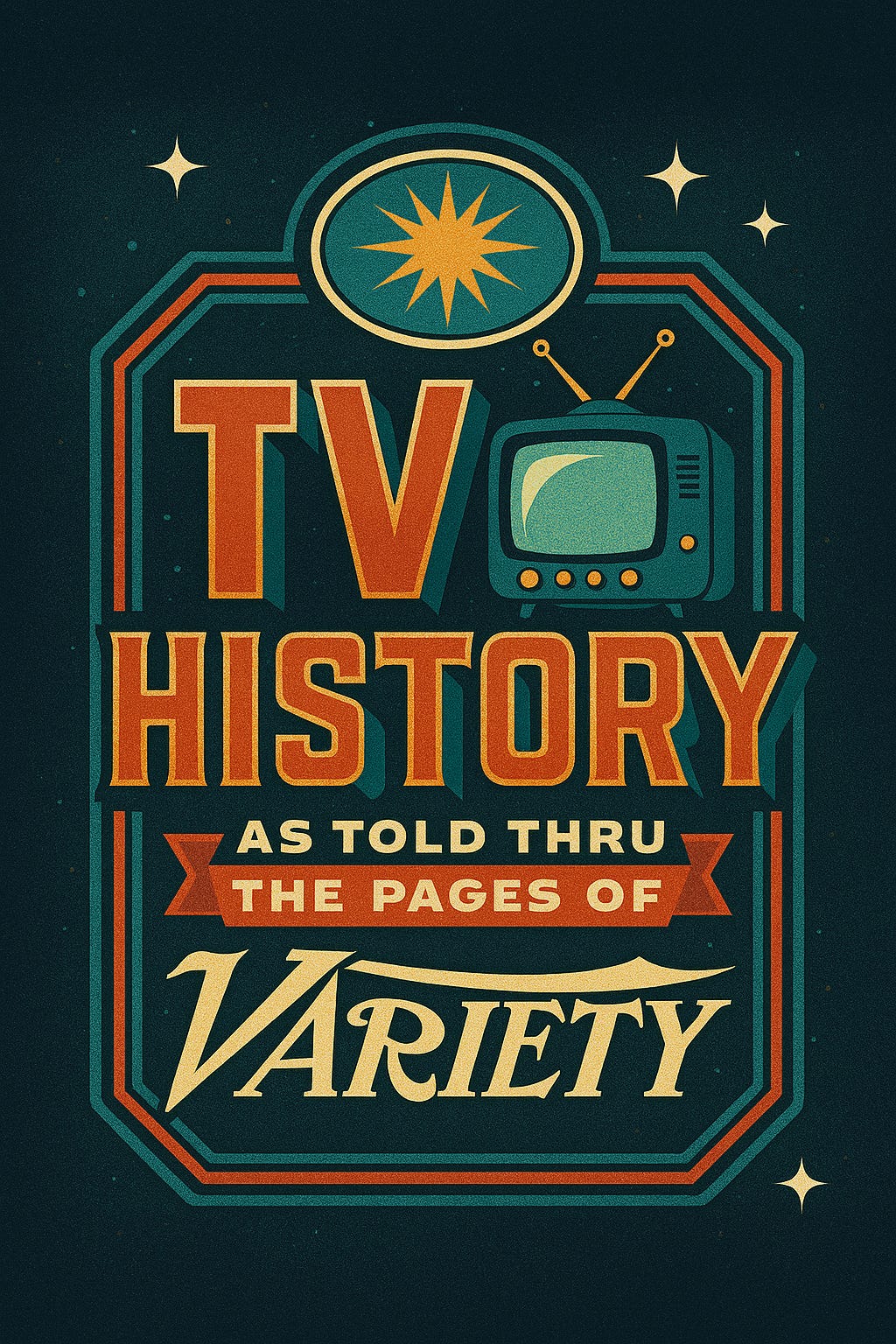
Here is Variety from 4/30/69 as chosen by the random date generator.
Back in the 1960s the contest to be the #1 network was REALLY important - far more than now when linear networks are so diminished, although they are more vital than people think. No matter the era, there have always been nuances in the data and ways for multiple networks to claim victory (it’s even more fuzzy in the streaming era).
This article covers the two ways that the 1968/69 ratings race was coming down to the wire and how NBC or CBS could declare themselves the winner. The discrepancies involve 1) which ratings service to use, Nielsen or Arbitron and 2) what season start date to use 9/15 (NBC’s choice) or 9/23 (CBS’s).
The U.S. government did not officially ban cigarette advertising on TV until 1/2/71 but by mid 1969 the networks and station groups were self-regulating. In these three articles the Post-Newsweek & Group W stations declared that they would no longer take cigarette ads, NBC announced that they would deemphasize smoking in their TV shows and NBC + ABC stated that they would air more anti-smoking PSAs.


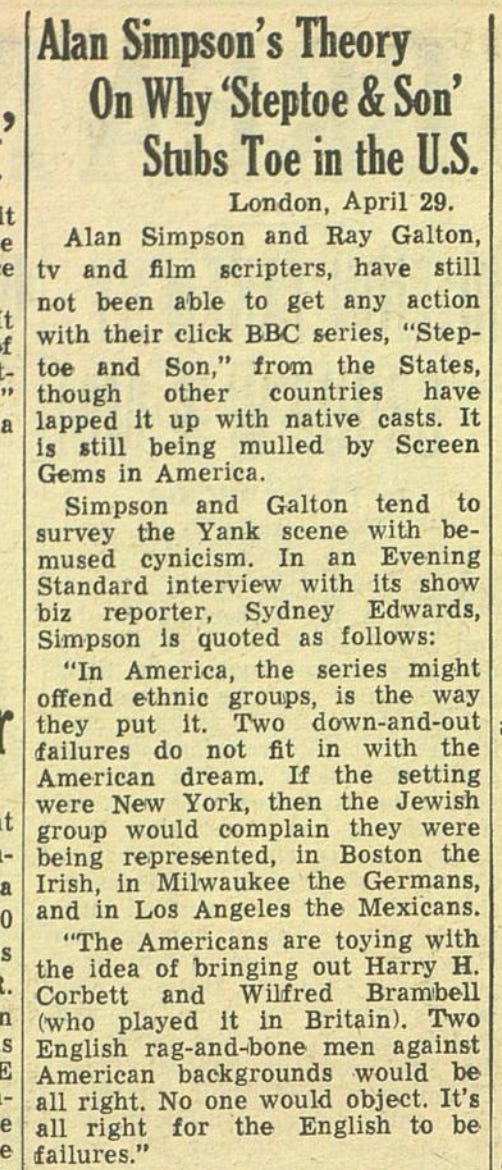
In this article the creators of the British comedy Steptoe and Son discussed how no U.S. studios have adapted their series about father-and-son junk dealers even though other countries had. In their opinion, the concept “might offend ethnic groups. Two down-and-out failures do not fit in with the American dream.”
Those two men, Alan Simpson and Ray Galton, would have to wait another three years but NBC would eventually order a domestic version and call it Sanford and Son which would become the breakout star of the 1972/73 season, ranking #2 overall, last for six seasons, and become a success in syndication.
It is unusual to see an article about the struggles of a potential program knowing that a few years later it would become one of the most successful comedies of a decade.
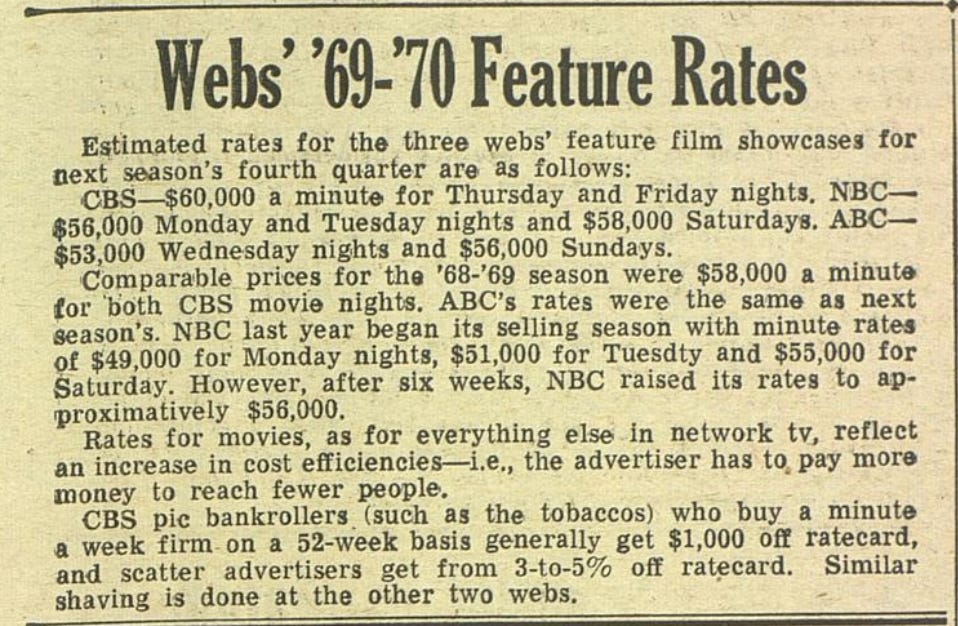
Here is what it cost to advertise on national Broadcast television in the 1969/70 season. Rates varied by night and ranged between $50K-$60K per minute. That translates with inflation to $442K in 2025 dollars or $221K per 30 seconds, a low rate today for a national spot.
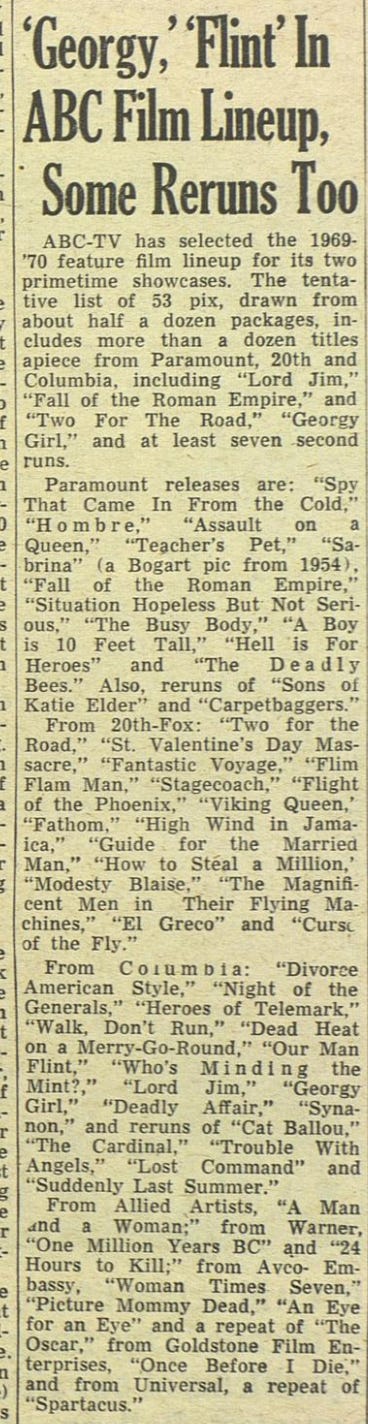
For the majority of their lifespan the theatrical movies that Broadcasters licensed each year mattered, alot. The most popular titles helped crown each season’s winner. In fact the topic was important enough for Variety to report on ABC’s upcoming slate.
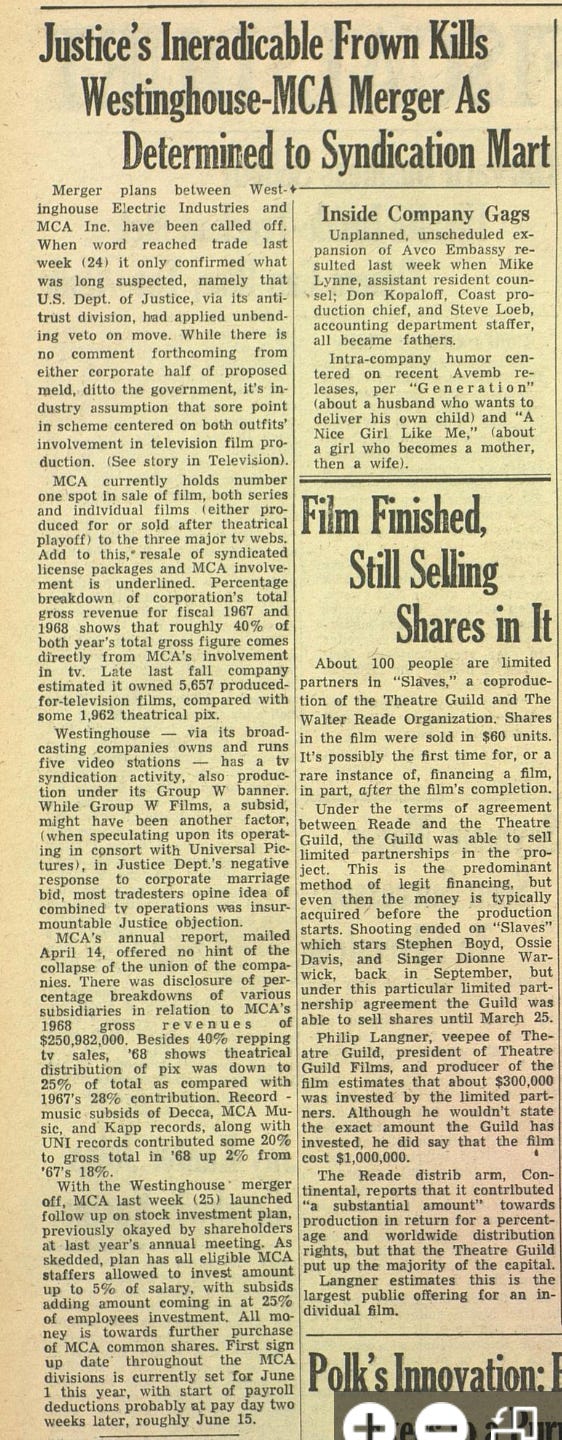
Another media merger blocked. In 1969 Westinghouse, owner of Group W, and MCA planned to merge which would bring together two strong studios/syndicators. The Justice Department saw that combination as monopolistic and vetoed it. Today the government is allowing far bigger transactions, but not all.
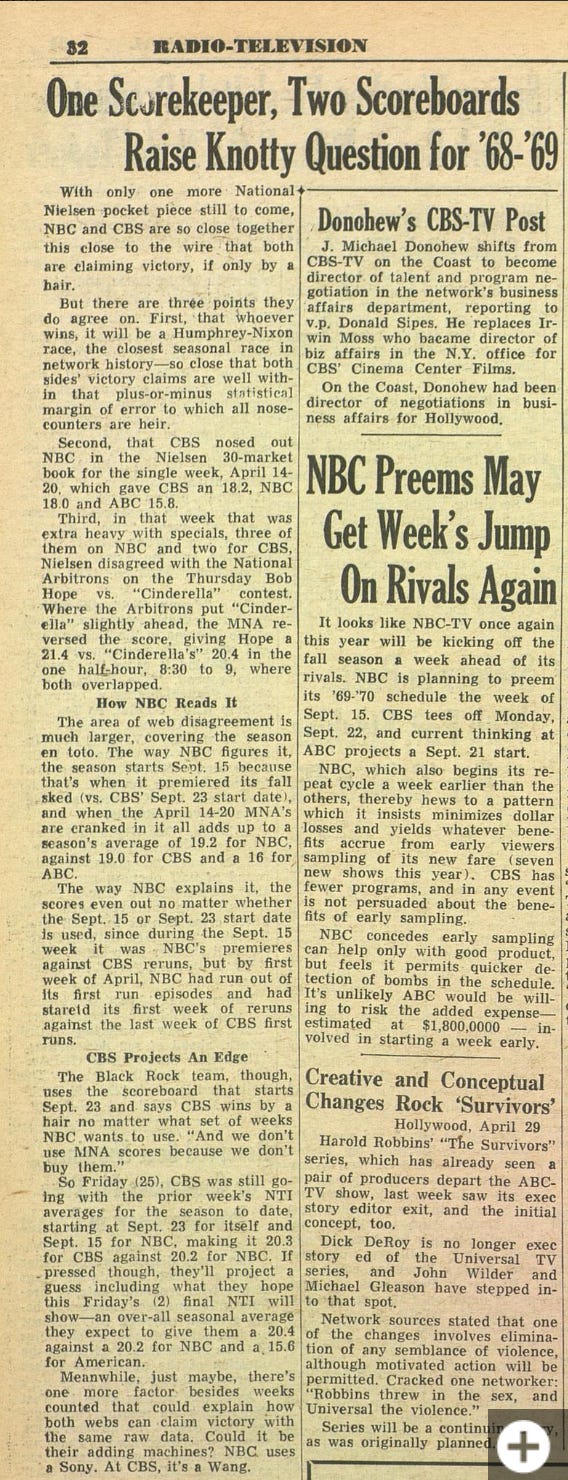
In mid-century America the future was looked at optimistically thanks to the vision of Walt Disney and the 1939 & 1964 World’s Fairs. In those middle decades local and national news would look ahead to the way life would change for the better in the next 10 years. At the dawn of the 1970, with cities in trouble post civil unrest, we see the tone start to change as shown here with NBC’s NYC affiliate placing this full page ad marketing “more than thirty programs” that will address the question “What will urban life be like in the next decade? One thing is certain, the problems of our cities will pose the greatest challenge. And foremost will be the finding of a solution to the psychological effects of city life on people.”