"Previously On..."
A recurring look at recent TV I've watched, notable industry news, items from my archive & their significance, and the history of TV programming as told through the pages of Variety.


I have published a new article on Forbes.com regarding the fact that Paramount and WBD will own 40% of the top acquired content on streaming, which can be read here.

The Pitt: I find it very hard to believe that a deposition would happen on July 4th.
The Oscars: In the 1980s, I remember looking forward to watching The Oscars each year because it was a prestigious event that celebrated not only the art of movies but also the business behind them, since popular films were often nominated. I even attended in 1984. At some point in the last decade, the show became a sanctimonious and arrogant bore that looks down on most television and movie viewers. In fact, I stopped caring about all award shows, even the Emmys, some time back, and find them more painful each year. There are also too many of them. I like Conan so I watched his segments, which were OK. I hope YouTube finds a way to make The Academy Awards a populist event again, instead of an elitist one.
War Machine (Netflix): Speaking of populist entertainment that will never get nominated, this was a really fun sci-fi action film that is better than most Netflix original movies. A lot of the oomph rests on the charisma of lead Alan Ritchson (Reacher), who single-handedly drives each scene and saves the world. It’s a fun 90 minutes if you are looking for something escapist.
Ted (Peacock): I love most everything that Seth MacFarlane does, and The Orville is one of my favorite TV shows of all time. I also love Ted, both S1 and now, S2. I have not watched the movie(s) in a while, but I might go back and revisit them after finishing the new season, which unfortunately is the last. I just wish there were more than eight episodes.
Kay Scarpetta (Amazon): I have never read any of Patricia Cornwell’s Kay Scarpetta novels, so the many differences that have been reported between the new series on Prime and the books do not bother me. After three episodes, I am finding the show only mildly entertaining as it is a bit confusing. Also, Jamie Lee Curtis is annoying as Scarpetta’s sister. I will probably finish the show, although I’m not sure I know what’s going on.
Rooster (HBO): The pilot to this new comedy starring Steve Carell was enjoyable, but by the end, I just didn’t care enough about the world that was built around him, so I do not plan to watch any more
The Madison: I had a similar reaction to this new Taylor Sheridan series. The main difference between this program and all of his others is that there is no villain for our protagonist(s) to battle. The premise involves a family led by Michelle Pfefiffer and Kurt Russel who move to Montana following a tragedy that I will not spoil. The lack of an antagonist is made very clear in the official show description: “The Clyburns uproot their comfortable New York City lives to the wild, untamed beauty of Montana’s Madison River Valley on a search for connection.”
I enjoyed the first episode enough, but I am not one for series about a family’s inward, spiritual healing. The description of the next two episodes is not enough to keep me going: “Ep 2) A neighbor’s kindness guides Stacy towards a bold choice; Ep 3) Stacy confronts Abigail about her future, triggering a roadside reckoning”.
Jury Duty: Company Retreat (Amazon): I really enjoyed S1 of this prank show, but S2 is a drag and really just a lame clone of The Office instead of honoring the original premise of one real person surrounded by actors. Instead of being set in a jury trial, the new season is set at a company retreat, and the non-actor is a temp hired to work at the fake hot sauce firm’s annual retreat. The biggest problem is that the actors stay in character in unfunny, Office-type scenes, even when our hero is not around, which completely defeats the purpose of the show. These scenes are not funny, and there is no reason for the audience to watch fake scenes in the real world that we are in on. Also, the stakes of a company retreat are too low vs. a jury trial, even if the fate of the company is supposedly on the line.

Taylor Frankie Paul: Back in September, I wrote that hiring the Mormon Housewife to be The Bachelorette was a risky but potentially lucrative casting decision considering the popularity of that show, but as a fan, I thought it was a joke and I did not expect to enjoy it. Clearly, my heart knew more than my brain in this case, given the implosion that has happened. An important pretense of the show is that the lead is earnest, wholesome, and interested in love. Paul’s casting was clearly done out of desperation for a franchise that has veered way off course and is now on life support. I do not think the show is definitely dead and buried, but it will need another year or two to find a way to recover, even if S22 eventually lands somewhere. This is a good example of why moving reality TV stars across shows needs careful consideration. Bravo already overdoes it.
Stewie (Fox): I was actually quite shocked when Fox announced a spin-off of Family Guy featuring its lead character. Animated spin-offs are not that frequent. The Simpsons has never had one, and Family Guy has only had one, The Cleveland Show, but that featured a secondary character. Family Guy is already the Stewie show each week, so now Fox is doubling down and essentially making Family Guy a year-round show. I assume there is a financial benefit to starting a new show, vs just ordering more Family Guy episodes, but I can’t imagine the savings are that significant. Either way, this is a very unusual, perhaps unprecedented, move. As noted above, I am a big Seth MacFarlane fan, so I am excited about Stewie, and the show will almost assuredly be a good asset for the Disney library, but I would have expected Fox to find a more creative way to leverage the Family Guy IP.
First-Run Syndication: I wrote about the challenges of first-run syndication for Forbes after The Kelly Clarkson Show was cancelled, and in the last week, we have seen the industry find both risks and opportunities in the category. The risks were highlighted by NBCU’s decision to shut down all of its remaining series — Access Hollywood, Access Hollywood Live, Karamo, and Steve Wilkos. I have a personal connection to this story because I sat with the team that oversaw these shows when I worked at NBCU, and I am saddened by the impact on them. I did not expect any studio to completely shut down all of their remaining first-run shows in one swoop, but the decision reveals how troubled the financial outlook is. On the other hand, The Drew Barrymore Show was renewed for two additional seasons by CBS, which is a bit ironic considering that network was the first to exit Late Night. As local stations find more and more financial reasons to program news and off-network programming in a world of declining linear ratings, the sacred cows are evaporating.
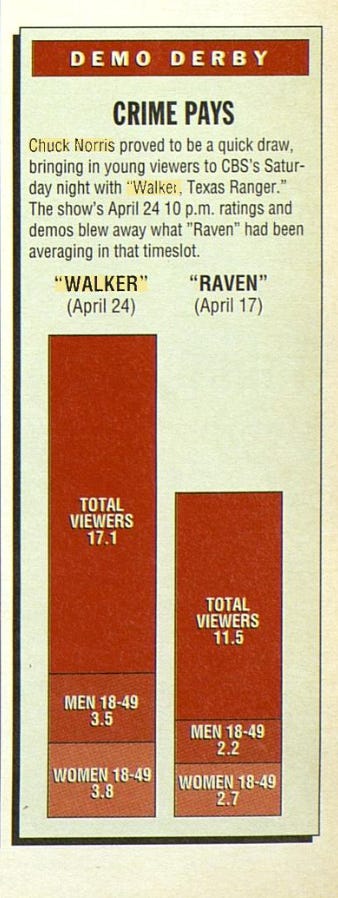
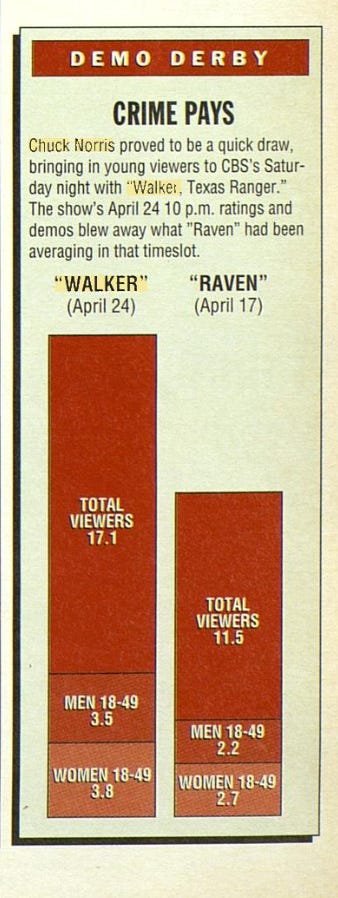
Walker, Texas Ranger: In honor of Chuck Norris’ passing, let’s take a look at the success of his CBS hit, which had to overcome numerous odds. When it first aired in April 1993, the show was an immediate success, which earned it this infographic from Variety documenting growth vs. the prior Saturday 10 pm timeslot holder.
Despite the impressive start, the show faced two significant hurdles. The most threatening was that the original studio, the cult 80s movie outfit Cannon, which made seven of Chuck Norris’ theatrical movies, ran out of money after four episodes in season 1 when it faced severe financial challenges. This turned out to be a blessing for CBS / Columbia, now Paramount / Sony, who took over the financing and now co-own a very valuable asset. The other was an intense focus on violence on Broadcast TV in 1993, which CBS was able to get past.
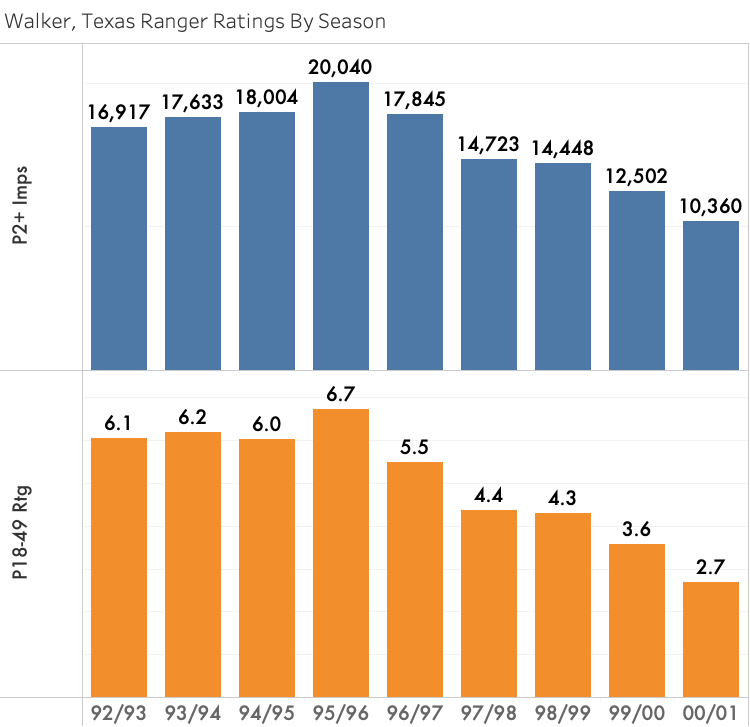
As the chart below demonstrates, Walker averaged between 17-20M viewers in the first five seasons and then went to 14-15M, and ended at 10M viewers. Its peak rank was #9 for the 95/96 season. By the time it ended, it ranked 58th.
In the P18-49 demo, the show was at a 6 rating or higher for S1-S4 and then declined steadily, getting to under a 3 by the final season. It ranked mostly in the 50s.
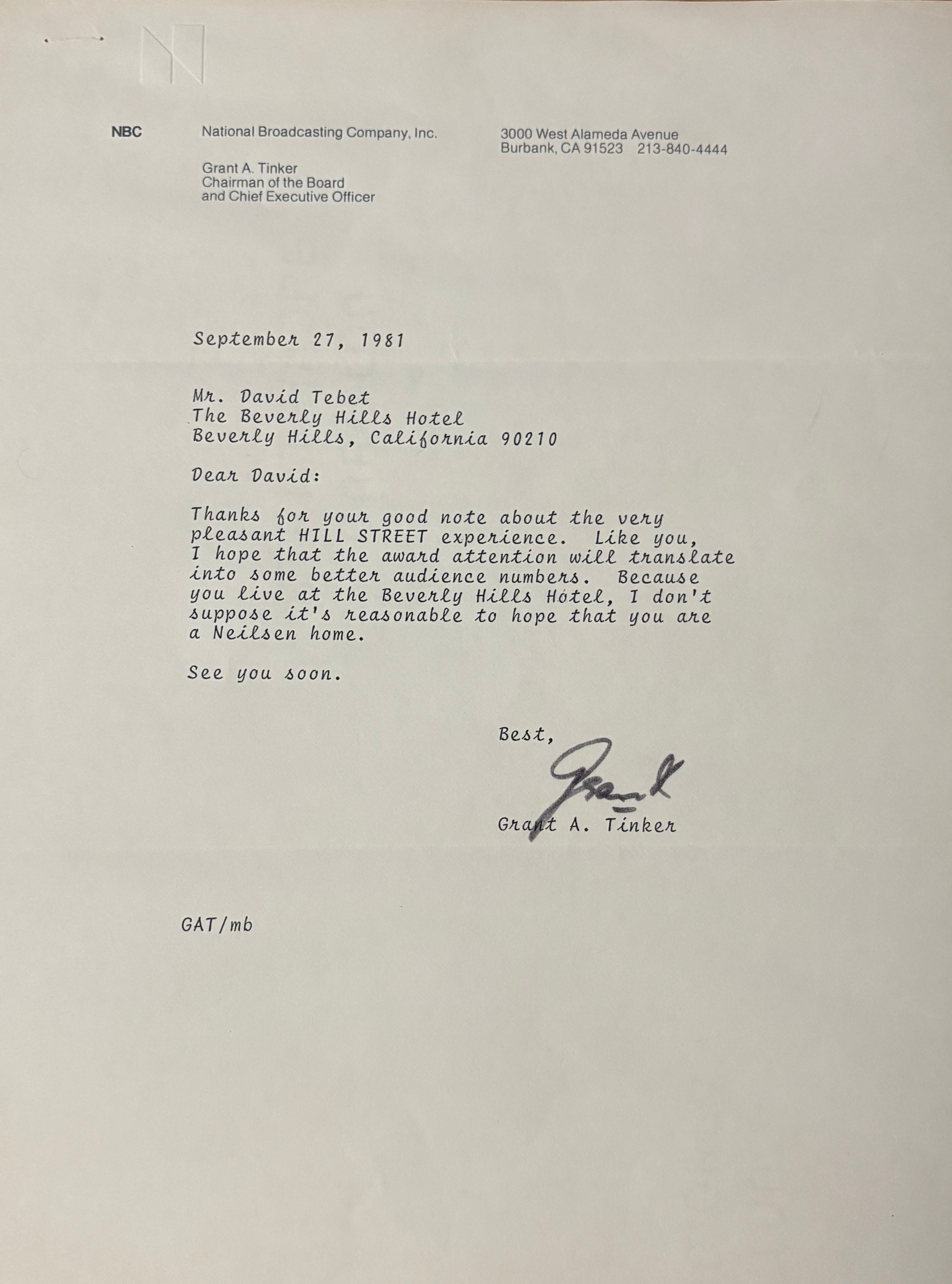
A great-content letter from legendary NBC chief Grant Tinker to former NBC talent relations head David Tebet, who later ran Johnny Carson’s production company. This letter has particular meaning to me because it mentions Nielsen ratings, even if Tinker misspells it (Neilsen), and Hill Street Blues, which had just begun its second season and would go on to revitalize NBC.
This week, the random Variety issue comes from June 8, 1960


People lament that Hollywood is falling apart today because of AI, streaming, and mergers. But Hollywood has always been falling apart. The page one cover article starts with a sarcastic call out to the “cost accountant”, aka a business affairs executive, who manages and trims costs, which is a symbol of the downfall of the industry. The article notes that “television is no longer the medium of show biz, but the medium of tedium, run with about as much excitement as prevails at the corner hardware store… The ability to size up a half-hour or hour vidfilm entry, with a subsequent order for delivery (today’s major function of a program dept.), carries with it about as much creativity as the guy running the aforementioned hardware store.”
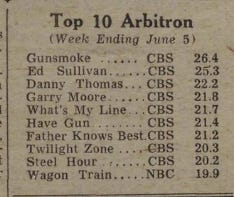
The #1 show for the week ending 6/5/60, Gunsmoke, is still one of the most popular programs on television. The rest of the top ten is a mix of unscripted (Ed Sullivan, Garry Moore, What’s My Line), scripted (Danny Thomas, Have Gun Will Travel, The Twilight Zone, Wagon Train), and the last vestiges of live TV (Steel Hour).
Other shows besides Gunsmoke in the 1960 top ten that are still on linear TV today are What’s My Line on Buzzr, Twilight Zone on Syfy and MeTV, and Wagon Train and Have Gun Will Travel on MeTV.


Another example that the problems of the entertainment industry today are more like the problems of the past than not. In 1960, there was a writer’s strike that lasted 148 days. Here, the networks pledge to run reruns until the strike ends, a strategy that would eventually become standard, alongside backup programming. However, in 1960, taped content was still young, and this was only the second writer’s strike, following the 14-week 1952 strike when TV was still in its infancy, and most programming was live.
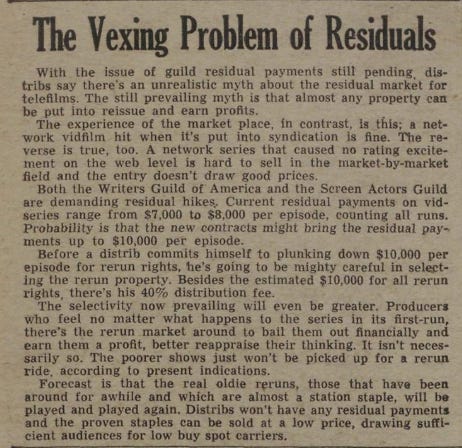
The main topic of the writer’s strike was residuals for the growing library of television shows that the networks were creating and local stations were paying for. This article points out that most shows are not strong enough to warrant a syndication sale, but there are some that will be watched in reruns over and over again -a fact that still drives the industry today.
The selectivity now prevailing will even be greater. Producers who feel no matter what happens to the series in its first-run, there’s the rerun market around to bail them out financially and earn them a profit, better reappraise their thinking. It isn’t necessarily so. The poorer shows just won’t be picked up for a rerun ride, according to present indications. Forecast is that the real oldie reruns, those that have been around for awhile and which are almost a station staple, will be played and played again. Distribs won’t have any residual payments and the proven staples can be sold at a low price, drawing sufficient audiences for low buy spot carriers.
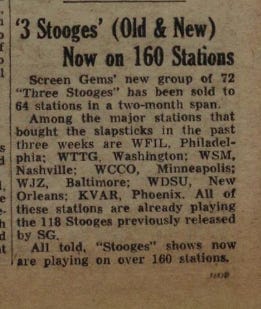
Another show that still airs on linear TV is The Three Stooges, on MeTV, and here is news that a “new group” of 72 episodes was sold to 64 stations. Among the stations that signed up were WFIL in Philadelphia, now the ABC O&O WPVI, WTTG Washington, which is a Fox O&O today, and WCCO in Minneapolis, a CBS O&O.
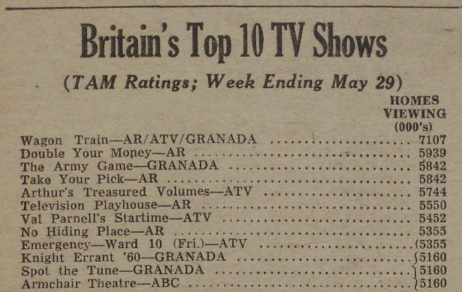
An American western was the #1 show in Britain in 1960: Wagon Train. The other series on this list are forgotten today.
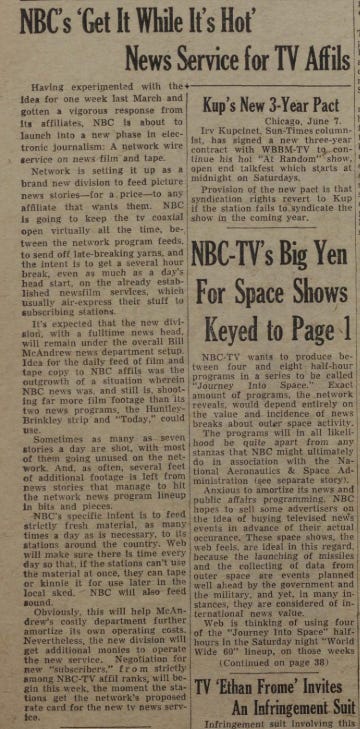
A very early version of CNN? NBC News planned to offer its affiliates a virtually continuous cycle of updated news stories and footage, when the norm at the time was a fixed number, given the technology limitations. “NBC is going to the keep the TV coaxial open virtually all the time, between the network program feeds, to send off late-breaking yarns, and the intent is to get a several hour break, even as much as a day’s head start, on the already established newsfilm services, which usually air-express their stuff to subscribing stations.
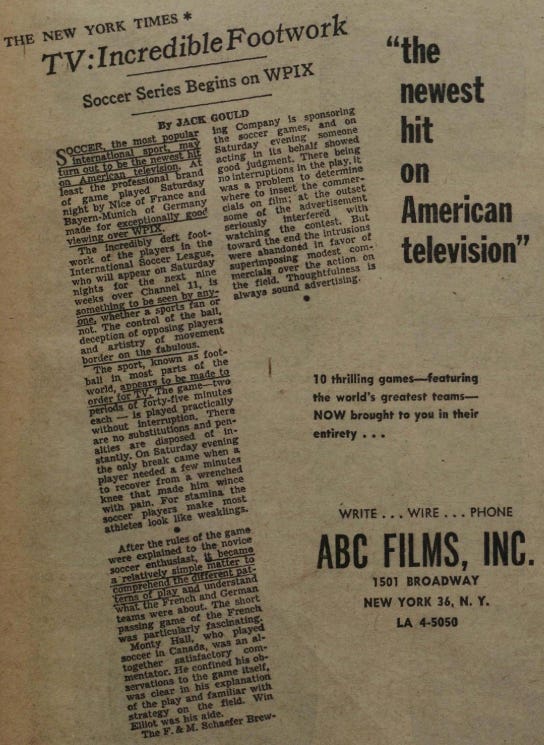
It’s been a long road for Soccer to reach its current level of popularity in the U.S. after many years of false starts, but even as early as 1960, there was an attempt to make it a bigger deal domestically.
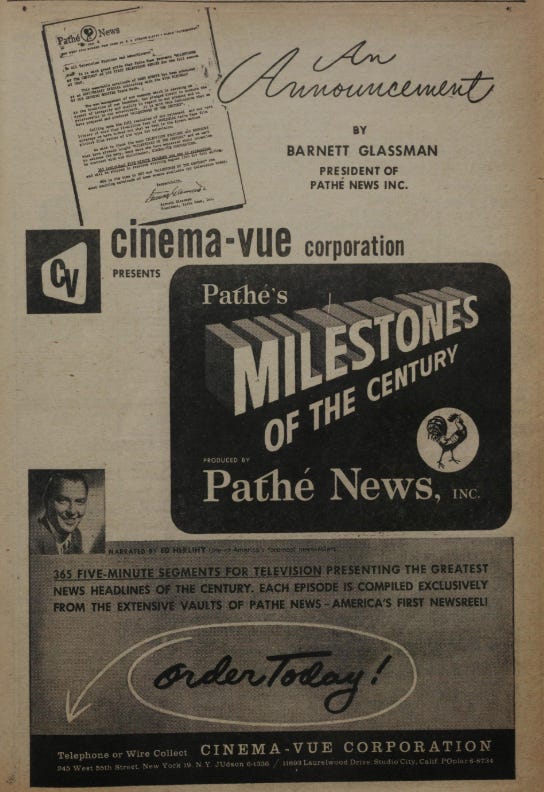
This ad seems quite retro even for 1960, when you consider the design, which I love, and is very mid-century modern 1950s, and the content being sold, five-minute historical news segments which were designed for movie theaters of the 1940s.