"Previously On..."
A recurring look at recent TV I've watched, notable industry news, items from my archive & their significance, and the history of TV programming as told through the pages of Variety.


I Will Find You (Netflix): The latest Harlan Coben mini-series is like all the rest: ridiculous, full of plot holes, but very bingeable. I finished it in 24 hours. It doesn’t really matter what it's about or whether the acting is good. The absurd plot twists and family-in-jeopardy plot devices keep you watching. I find them especially good for multitasking; they keep me company when I cook. They are a mindless, entertaining ride that you forget about soon after you finish, but that’s just fine.
Not Suitable For Work (Hulu): The characters in this single-camera comedy from Mindy Kaling about a group of young people navigating life, work, and romance in NYC (sound familiar?) are irritating, not funny, and very cliché. The acting and the dialogue are forced, the plots dumb or predictable or both, and there are sooo many lines devoted to expository set-up. Comedies can take some time to gel, but I am not giving any more of mine to find out if this gets better. I laughed once, at a line said by Questlove in a cameo.
Million Dollar Nannies (Freeform / Hulu): Well, I tried to watch this new follow doc that utilizes Freeform linear as its anchor base but will get most of its audience from Hulu. I could not last more than 15 minutes with these annoying, insipid people being overly performative. Good docufollow shows allow the viewer to believe they are covertly viewing someone else’s life. I did not believe the people in this mess were anything more than actors hired to be “nannies”.
Life, Larry And The Pursuit of Happiness (HBO / HBO Max): The appearance of President Obama in the show is notable but not really that important, as the main gist is Larry David’s sardonic take on important American historical events in a series of sketches, 3-4 per show. The concepts are all funny but some of the jokes fall a little flat or go on a bit too long. While not as funny as any standard episode of Curb, if you are a Larry David fan you will likely enjoy it. Jerry Seinfeld, Rob Reiner, and Jimmy Kimmel make cameos in E2.

Nielsen’s The Gauge Report: Oh goodie, another week of pseudo-media people on LinkedIn trying to report on non-existent insights in a way-too-macro report on TV viewing shares that do not matter at a monthly cadence. I am one of the bigger champions of Nielsen you will find in TV research, and it’s not the company’s fault, but the overreactions to The Gauge force me to exercise my scrolling and swiping muscles to avoid the nonsense.
NBCU To Go Public: As its legacy peers continue to consolidate, Comcast needed to do something to address the hurdle that NBC Universal cannot thrive on its own anymore. Peacock is stuck, the linear assets are facing the obvious industry headwinds, the TV studio is not nearly as iconic as its peers, and as good as the movie studio is, it can only release so many titles in a year. The theme parks are great, but that in itself makes NBCU an even riper target for others who want turnkey entry into that business. So when I saw Monday morning that Comcast was spinning off NBCU, the words that came to mind were “it’s starting”. No matter what is said publicly, I think senior leadership knows a sale or merger is inevitable, and this just makes it easier.
Of course, the big question is who will be the partner/buyer. While there are obvious candidates like Netflix or other large streamers, there is just as good a chance that it could be a name nobody suspects. There is a rich history of companies in other industries stepping into the media space. Coca-Cola, Vivendi, Gulf & Western, GE, AOL, General Tire and Rubber, Kinney National, and Sony are excellent examples of conglomerates that diversified into big media over the last sixty years. A few years ago, NBCU almost merged with Electronic Arts, according to Puck.
There are multiple paths forward here that have been discussed in the subsequent analyses. 1) NBCU won’t even get to go public, as a merger will happen earlier; 2) It could be a buyer to try to bulk itself up; 3) private equity might get involved if the company is split up for parts. All of these are indeed possible, but I put less odds of #2 as a long-term possibility. I do think its assets are too attractive and that at some point before 2030 there will be a deal in place for NBCU to become part of another company.
There is one scenario that would be ironic and not completely far-fetched. Parts of NBCU end up with different suitors, and Peacock is absorbed into Paramount Plus / HBO Max. If that happens, Taylor Sheridan ends up back in the Paramount fold.
NBCU executes on its content at a world-class level. However, the existential problem it has always faced is now rearing its head and is one that does not get discussed widely - an inferiority in owned TV content. It lacks the iconic and format firepower of its rivals. During the 1960s and 1970s, Universal Television focused on character-driven one-hour shows, which are hard to reboot and not as repeatable as the format-driven one-hour and multicam sitcoms that are inside Sony, Warner, Paramount and Disney (via 20th). Many of the shows that drove NBC to new heights in the 1980s and 1990s are owned by other studios. A good chunk of the content that propels the company today is also owned by others, including all sports, Love Island, Harry Potter and Nintendo in the theme park, Yellowstone on Peacock, The Voice, AGT, and The Traitors. Luckily, it has Dick Wolf.
The movie library is stronger but still not as deep or broad as its rivals.
While all media companies license content to some degree, NBCU leases more of its most important TV properties than its peers (I say this from observation, not a rigorous analysis). This puts the company in a precarious state when content ownership is vitally important, but despite that challenge, somebody out there will want to either enter or get deeper into the exciting business of show, and NBCU is the next, best available gateway.
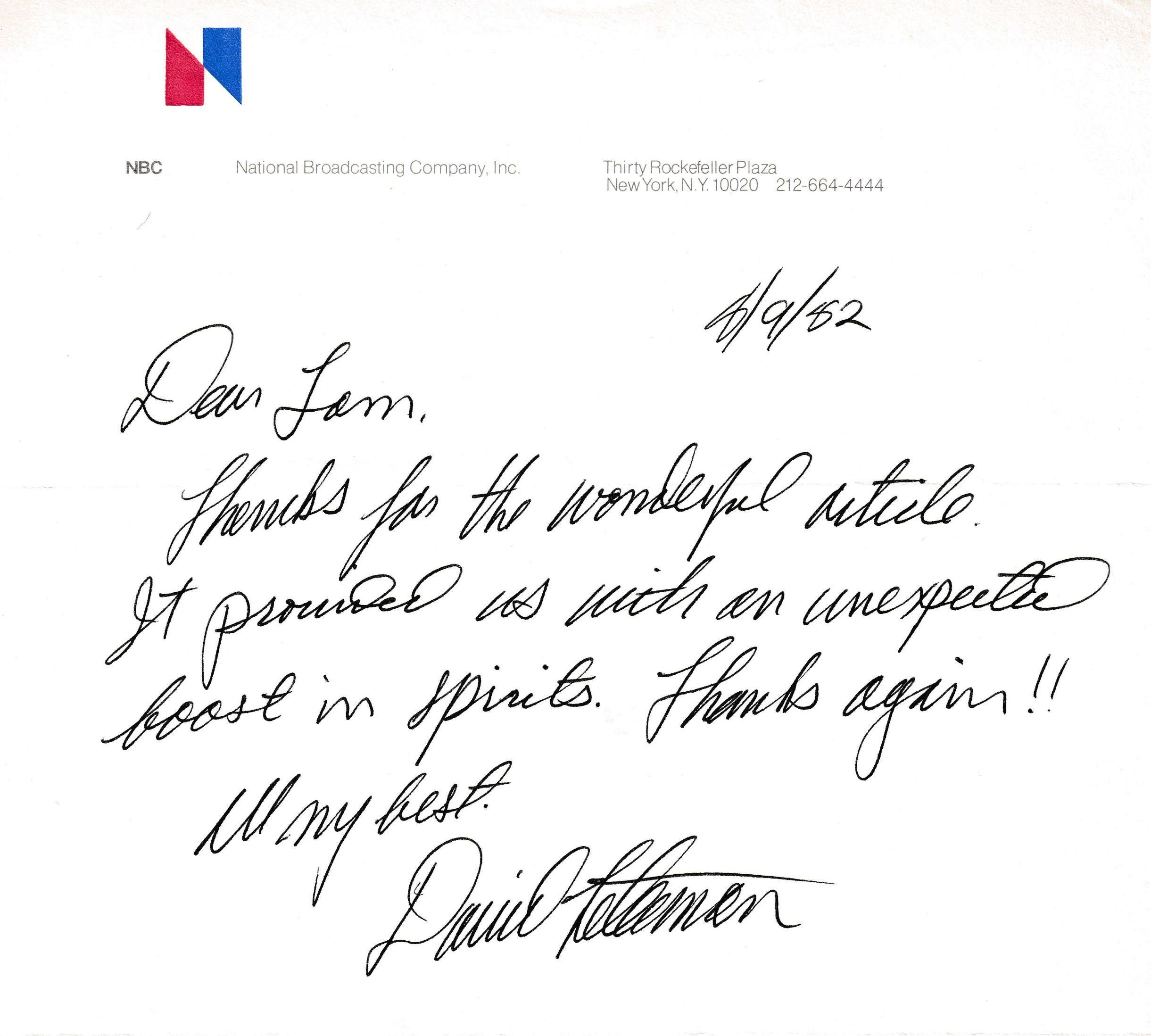
I recently acquired a collection of letters written to the late Pulitzer-prize-winning TV critic Tom Shales, who died in 2024. I will share them over the next month or two. This first one is quite remarkable.
A handwritten note from David Letterman on NBC stationery dated 8/9/92, just seven months after Late Night began. He thanks Shales for “the wonderful article. It provided us with an unexpected boost in spirits.”
I could not find an article around the time of this letter, but in his review of the premiere, Shales said, “The premiere of NBC's new David Letterman show was a shaggy triumph. It's going to be awfully nice to have this warm little outpost of acerbic mirth waiting there in the Yukon of post-midnight programming. David Letterman, the light at the end of the tunnel. Or something.”
This week’s historical Variety issue comes from 6/7/67


In June of 1967, these four pages alone reveal that three major show business corporations were involved in merger activities.
Edgar Bronfman Sr., CEO of Seagrams, took a controlling interest in MGM and for one year was its Chairman before he resigned and sold to Kirk Kerkorian. The article here covers financial maneuverings surrounding the deal. 28 years later, Bronfman’s son Edgar Jr. would buy a controlling interest in MCA / Universal.
Warner Brothers was taken over by production company Seven Arts in June 1967, and the article reports that after the deal closes, the Warner Bros. name would be inside the name of the new company, and it was, “Warner Bros.-Seven Arts”. After Kinney, the line of ownership was: Time Inc → AOL → AT&T → Discovery → Paramount.
ABC and the international telecommunications conglomerate IT&T planned to merge, but at the time of this article the Justice Department had blocked the deal, even though the FCC approved it, on fears that IT&T would become too big and could exert editorial control on ABC news in its favor. The article covers the fact that the proposal was going back to the FCC for another vote to see if that could help push back on Justice. The merger never happened.
Today’s Relevance: If you think the current M&A state of the media industry is unprecedented, you are wrong. In fact, pick a decade, and you will find multiple successful and failed mergers that either reshaped the industry or would have, had they gone through. On the same date in 1967, ABC, MGM, and Warner Bros. were all part of the swirl, and while all three of those companies appear settled now, no one should be surprised if they are in play once again in the 2030s.


Two articles of note on these pages.
On the right side is the little-remembered story of an attempt to create a fourth TV network in 1967. The United Network - not to be confused with United Paramount Network (UPN) - was originally created by a warehouse owner who diversified into media and attempted to launch a national network with eight hours of Primetime and hired a former head of ABC to run it. That plan failed due to financial issues in the warehouse company, and he sold what had been built to the Mutual Broadcasting System, which christened it United.
United was only able to launch one program, a late-night talker starring comedian Bill Dana called The Las Vegas Show, but it only lasted 23 episodes. The ragtag group of 100-ish stations included some CBS affiliates. The Variety article concerns the fact that CBS affiliates at the time wanted the network to produce a series for late night, but during the run of The Las Vegas Show, when NBC also had Carson and ABC had The Joey Bishop Show, the movies that CBS scheduled in the daypart improved in the ratings. This led CBS to wonder if the affiliates still wanted to compete with an original talk show.
Today’s Relevance: As late night starts to wind down in the second half of this decade, this is the first instance when a network launched by utilizing Late Night as its entry point. The second time was far more successful, which was Fox with The Late Show hosted by Joan Rivers. These are examples of how Late Night used to be so integral to Broadcast operations.
In 1967, CBS was the strongest of the three networks with the most Emmy nominations, a sweep of all daytime slots, #1 in Prime, 4 of the top 5 series and 13 of the top 20, 8 of the top 10 Saturday morning cartoons, and six of the top ten specials. This led to a very happy CBS affiliate group. The entire article is a celebration of the Tiffany network’s success.
Today’s Relevance: There is so little audience separating the main four networks, and so many fewer time slots to program, that no network can ever truly dominate the airwaves again. Broadcast ratings used to fall into a wide range where the hits could easily be distinguished from the misses. Today there is no such thing as a “hit” anymore - at least not in the way that term has normally been used.