"Previously On..."
A recurring look at recent TV I've watched, notable industry news, items from my archive & their significance, and the history of TV programming as told through the pages of TV Guide or Variety.


The Beast In Me (Netflix): Wow, I really hated the first episode of this show and turned it off with 20 minutes to go. Spoilers: Matthew Rhys plays a rich slimeball suspected of killing his wife and moves next door to Claire Danes, a best-selling writer going through the trauma of a dead child, writer’s block, and bankruptcy yet doesn’t simply tell him to go away as he insinuates himself in her life. I can’t watch female characters who are unable to stand up to creepy men - especially ones so blatantly obnoxious as Rhys is here. The last straw for me was when he breaks the phone of a looky-loo in a restaurant who takes a picture of him and there are zero consequences. Claire Danes just sits there, talking to him afterwards. Ridiculous.
Pluribus (Apple): Normally, high concept shows that are hard to explain are not for me, especially if they are wrapped in dystopia . I prefer more grounded, literal, rationale storytelling which is why I like procedurals so much. Additionally, I am not a fan of Breaking Bad or Better Call Saul. This explains why I did not expect to enjoy Vince Gilligan’s new series about a woman who has to face a dystopian-ish world event. However I enjoyed Gilligan’s X-Files episodes which may explain why I have really enjoyed the first three episodes of Pluribus. The storytelling makes sense, the characters are interesting, the acting is solid (especially lead Rhea Seehorn), and the plot is fresh. I hope the story progresses smartly for the remainder of the season.
All Her Fault (Peacock): I found the first two episodes of this serialized missing child clunky so I thought I would find getting through the entire series a slog. But from episode three on, the narrative became much tighter and I ended up binging the full season in 24 hours. I really wanted to see what happened to Milo (the missing kid) and why. I had not read the book on which All Her Fault was based which is why I found the resolution both surprising and engrossing. The star power of Sarah Snook and Dakota Fanning didn’t hurt either.
Broadcast 4Q Round Up: With many Broadcast shows wrapping up their Fall episodes as we get close to Thanksgiving here is my summary of returning series thus far.
The Chicagos: All three series have found their footing after a few seasons of hit or miss episodes but this year there have been almost no misfires. The highlight of the franchise STD is the chemistry and partnership of paramedics Mikami and Novak on Chicago Fire who I think could be spun off into a great P.I. series.
9-1-1: This season’s space-station storyline was ridiculous, and not in a good way, with bad special effects and dull cliffhangers. Now that the show has returned to Earth it has gotten better but without Peter Krause or another new lead, the program has lost an important foundation.
FBI: Without a full night of FBIs for the first time in four years there is something less special about watching just one show. There have been some solid episodes like the season premiere “Takeover” and the most recent “Falsetto” but also one of the worst in the eight seasons, “Manifest” with a trope-ridden, silly storyline set on an airplane.
NCIS(s): The mothership continues to hum along with entertaining episodes. Origins is a little better than last season and the two-part cross-over episode with Mark Harmon worked much better than I expected. NCIS Sidney wins “most improved” for the franchise. I cannot quite put my finger on what’s different but it no longer feels like that cheap foreign version put on the schedule due to the writer’s strike.
Law & Order & L&O SVU:
L&O: The initial six episodes of the Fall cycle for the original L&O were a first for the series after 25 years — only one lead detective as there was a gap between Mechad Brooks leaving and David Ajala joining to pair up with Reid Scott. The good news was that gave more time for Maura Tierney to be in the field and even the “computer lady” played by Connie Shi. All those episodes very solid meat & potatoes Law & Order - I can’t recall a specific installment but I enjoyed them all. However, the introduction of David Ajala was a bit overwrought as he ignored a piece of evidence in order to get a conviction. Hopefully his Det. Theo Walker will settle in better over time.
SVU: After 27 seasons TV’s longest-running drama remains one of the most consistently satisfying procedurals.
Shark Tank: I do miss Mark Cuban but this is still my favorite show on TV (yep, it is).
Survivor: The SVU of unscripted, on for 25+ years and consistently satisfying.
The Amazing Race: The combination of Big Brother cast members and European-only countries makes this an inferior season
Abbot Elementary: One of the better single-cam comedies on Broadcast but starting to show some aging. Nothing is really wrong; more that the comedic vibe is becoming less special.
Tracker: The opening episodes dealt with a preposterous storyline where one hacker managed to make people commit crimes. The Tracker brothers (Jared Padalecki guested) solved it quite easily in the end and thankfully the show moved on. It’s hard not to notice how Tracker has shed almost its entire supporting cast in two seasons but Justin Hartley is a strong series lead.
Matlock: The formula now is Matty and Olympia investigating Wellbrexa while also finding time to handle a “regular”, procedural case. Its working but for how long?
Elsbeth: I miss Carra Patterson as Elsbeth Tascioni’s police partner (you have to say her full name) but the show still delivers on its promise of a Columbo-like episodic mystery with a colorful, quirky hero.
High Potential: See Elsbeth, except for the partner issue.
Doc: TV is littered with medical shows that fail because they all feel very similar. Doc manages to be fresh, somehow. The gimmick of the lead character (Doctor Larson) losing years of her memory in a car crash still pays benefits and is not yet cliche. The cases are interesting and the mix of personal & professional drama is nicely balanced.


Poker Face’s Potential Next Chapter: The cancellation of Poker Face is not a surprise. Most high-end streaming series last only one or two seasons. The unusual part is that show creator Rian Johnson is trying to find a new home for a two-season renewal and that he wants to change the lead from Natasha Lyonne to Peter Dinklage.
I can recall no other show except for Dr. Who pro-actively looking to recast the lead character with a different actor from a different gender. I am assuming there will be some explanation and it won’t be the exact same Charlie Cale but apparently Johnson envisions a change of lead every two years.
Of course actors have replaced other actors in the same TV role but it’s usually a reactive move and does not involve a gender swap. The closest examples to a character change such as this on a drama that I can think of are Tony Musante leaving Toma to be replaced by Robert Blake’s Baretta or when Daniel Benzali left Murder One and was replaced by Anthony LaPaglia. If readers have other examples, please share (drama only).
This is a fascinating way to turn a show into a franchise and keep it rejuvenated although it can also alienate the fans every two years. But will anyone bite and pick-up the show?

NBC Fall 1975 Prime Time Analysis: Below you will find a link to a 50-page analysis from May 1975 about the upcoming Fall season and the network’s strategy behind its schedule. I have published a few key front pages as images below
The picture in the middle features data that indicates NBC was entering the 75/76 season in good shape on a HH rating basis. It was the only network up in the prior season (74/75) and was in a close second place to CBS. This was accomplished off the strength of such shows as Sanford & Son, Chico & The Man, The Rockford Files, Little House, and Police Woman.
Despite all the bullishness and confidence in the document, 1975/76 was a disaster for NBC from a new series POV. Below is the list of freshman programs - they were all flops.
City of Angels
Comedy Theatre
The Cop and the Kid
Doctors’ Hospital
The Dumplings
Ellery Queen
The Family Holvak
Fay
Grady
The Invisible Man
Jigsaw John
Joe Forrester
The John Davidson Show
McCoy
Medical Story
The Montefuscos
NBC Thursday Night at the Movies
The Practice
The Rich Little Show


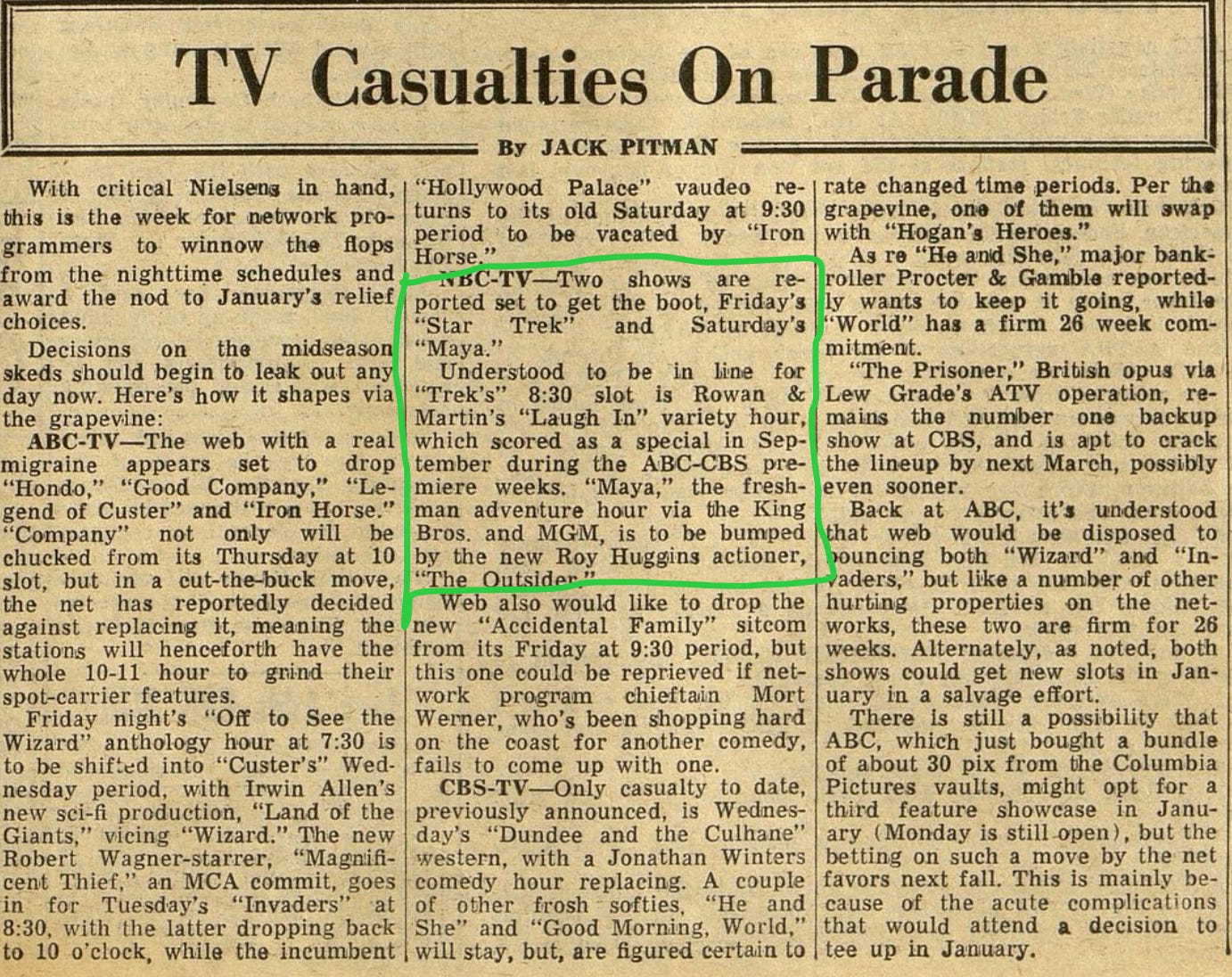
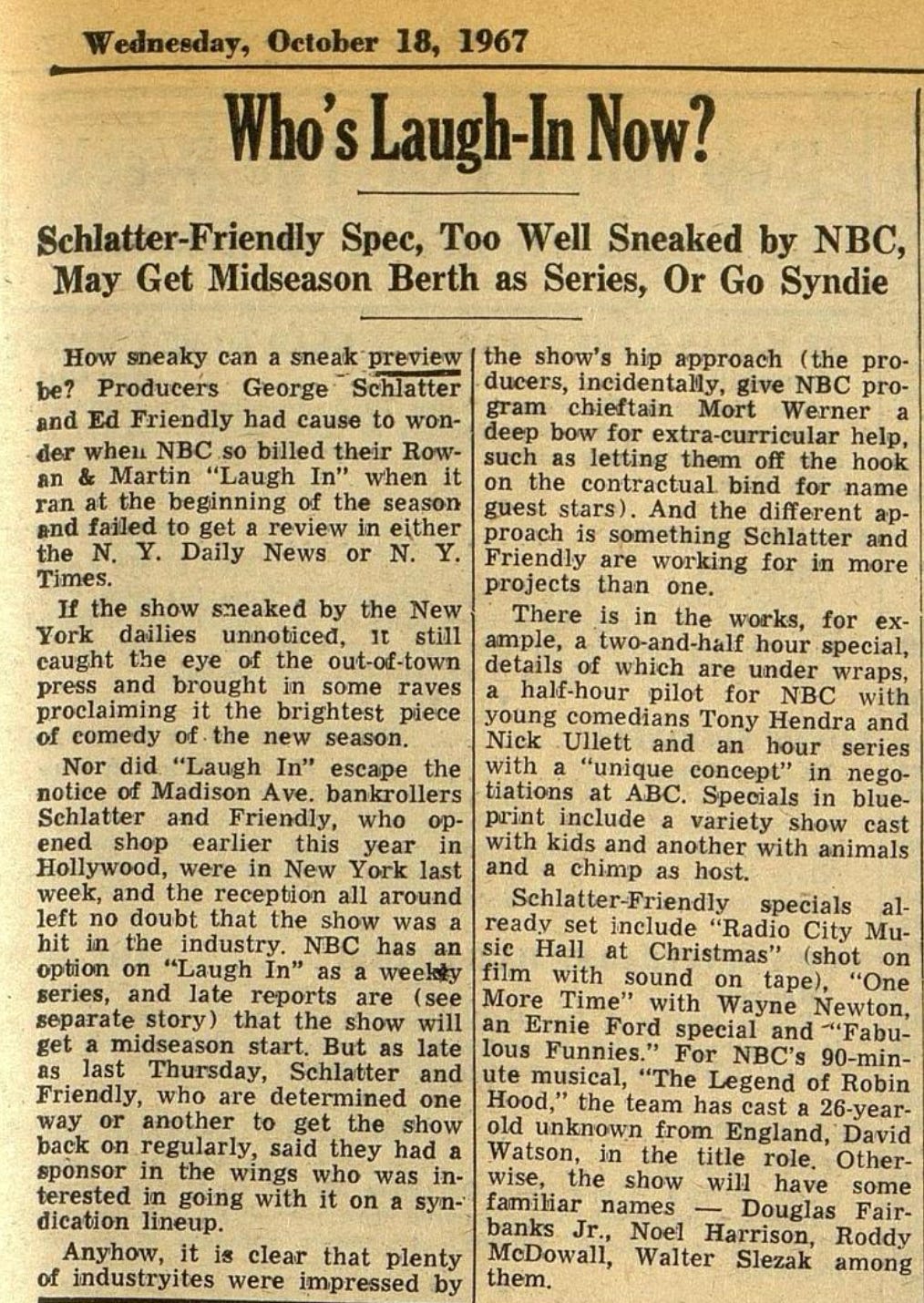
The random date generator led to the 10/18/67 edition of Variety.
This first article covers the shows that are likely to be cancelled during the Fall before they get a back-season order. If this article was correct Paramount would have lost more than $1B. Under the NBC section there is prognostication that Star Trek is “set to get the boot” and that the new series “Laugh-In” would take over the Friday 8:30pm slot.
At this point Star Trek was five episodes into S2 but it would, in fact, go on to finish out the season in the Friday 8:30pm slot and then get renewed for a third and final season. Of course that third season gave it just enough episodes for its meteoric rise in syndication. Laugh-In would air mid-season but on Mondays at 8:30p replacing The Man from U.N.C.L.E which was cancelled and never became a franchise. More on Laugh-In in a subsequent article.
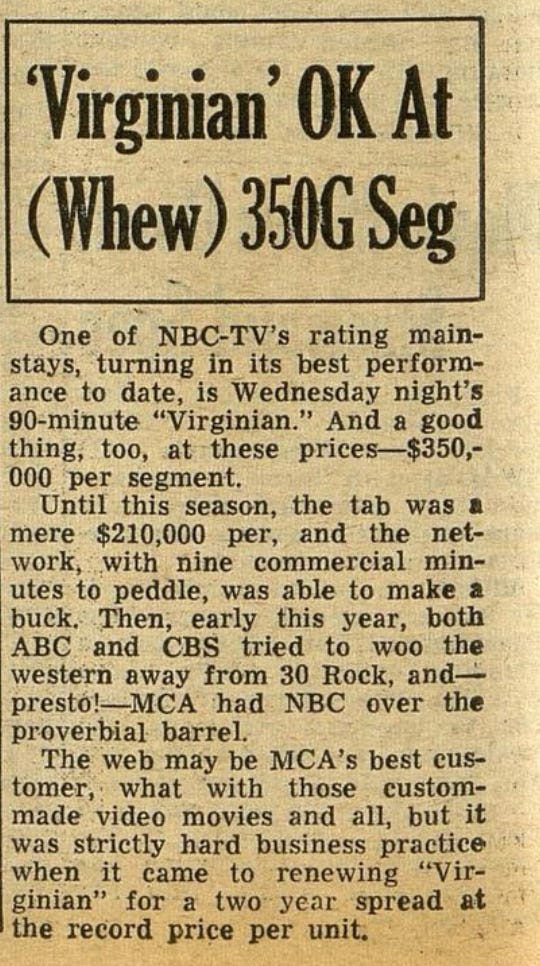
Variety was astonished by the price of the new cost, $350K, to produce an episode of the hit Western series The Virginian which was starting the sixth of its nine seasons. That was a 67% increase over prior seasons ($210K). Accounting for inflation that translates into $3.4M per episode which is still quite affordable compared to what scripted drama series cost today as demonstrated in this article.
The reason for the increase was that both CBS and ABC were trying to steal the show and since it was produced out of house, as most series were in the 1960s, the studio that owned it, MCA (now part of Universal), could charge NBC a significant rate hike if it wanted to keep the show. Most likely The Virginian was under a seven-season contract and the show could move networks in 69/70. NBC ponied up.
Rowan and Martin’s Laugh In would become one of the biggest pop culture sensations at the end of the 1960’s, ranking #1 for 68/69 and 69/70. It began as a special which aired 9/9/67 and here we see the early buzz on that special in which everyone, except a few NY papers, noticed its innovative style. Just three months after this article, on 1/22/68, the show would premiere and transform American television comedy with its micro-segments, catch-phrases and celebrity cameos.
This article covers one of the earliest attempts to nationalize public television programming called “PBL” or “Public Broadcast Laboratory”. This was going to launch soon and would be a Sunday night commercial free program on public TV stations funded by a $10M grant from the Ford foundation. The lead executive on the project was Av Westin who would later create 20/20 for ABC.
Each Sunday night telecast would “would tend to take one of two forms from week to week: either thematic, where-in the entire broadcast would be given over to a single subject examined in a number of ways, or as a magazine with three basic stories and a potpourri of cultural fare. The timely story would have priority and the fact that the program will be essentially live makes possible all manner of 11th hour revisions to subject matter.”
PBL only lasted two years but it is considered a forerunner of 60 Minutes.


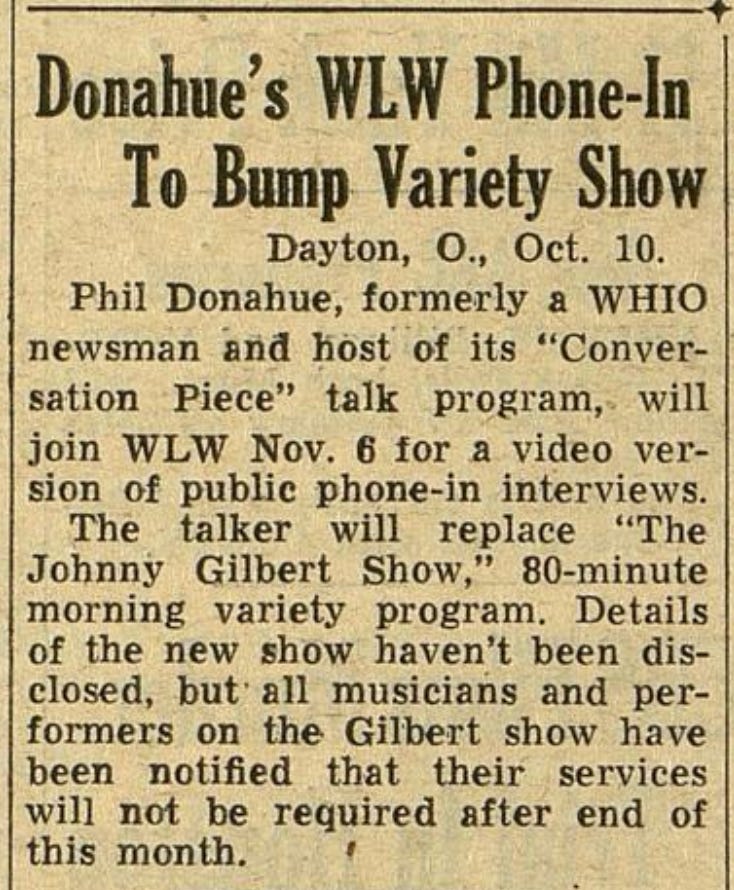
Without Phil Donahue there is no Oprah, no Dr. Phil, no Sally Jesse, no Jenny Jones, no Jerry Springer and no Ellen DeGeneres. But there is no Phil Donahue if he stayed a news anchor in Ohio. Here is very early reporting of his evolution into a talk show host which would launch the daytime talk genre.
Thanks Jason! Time for another meal?
Always love reading your work, Ted!