"Previously On..."
A recurring look at recent TV I've watched, notable industry news, items from my archives & their significance, and the history of TV programming as told through the pages of Variety.


Legends (Netflix): I found this six-part limited series based on true stories about UK customs agents who engineered very large drug busts in the 1990s a bit confusing but, ultimately, enjoyable. I was not able to keep track of all the characters, but the stakes were high, and the resolution was satisfying.
Kitchen Nightmares / Restaurant Impossible Last Call / Kitchen Undercover: (Fox / Food Network): I am a sucker for shows that feature failing restaurants receiving makeovers while the stubborn owner is confronted by a domineering chef.
The third season of the revival of Kitchen Nightmares with Gordon Rasmey didn’t make any significant changes to the original 2007-2014 run, and it didn’t need to. The chef-owners in this new season are as combative as ever, which makes for good TV, and Gordon Ramsey is … Gordon Ramsey.
Restaurant Impossible has also been revived on Food Network but without long-time host Robert Irvine. The show has moved to Toronto and is now co-hosted by long-time Food personality Aron Sanchez and Canadian restauranteur/author Jen Ogg, who is new to me. Irvine was a very strong personality in the original incarnation, and while the program is very different without him, the new version is still a fulfilling restaurant makeover series.
Kitchen Undercover stars Chef Antonia Lofaso, formerly of Top Chef, who partners with restaurant owners to spy on their workers and operations. The employees think they are on a documentary, although I am surprised people still fall for this ruse, and are not functioning well as a team. Chef Antonia and her star sous chef then reveal that they have been observing all the shenanigans and do what they can to turn things around. Another solid title in this genre.
Married At First Sight (Peacock): I have watched this series since season one and am enjoying the new S19, which has abandoned some of the show’s stodgier elements and added in some of what makes the UK and Australia versions much more entertaining (before the recent UK problems were known). I always liked Dr. Pepper and Pastor Cal, but new hosts Paul Brunson and Dr. Lisa Paz are also strong. While the show is still far more earnest than its sister shows across the Atlantic and Pacific, which also makes it duller, the conflicts this season are good enough to get me to the end.
Five Star Weekend (Peacock): I am a Jennifer Garner fan, but the rest of the supporting cast and characters in the first episode of this show were annoying and dull. The cloying plot(s) and overacting didn’t help. I know season one did well, but that was boosted by Love Island and the World Cup. I predict S2 will drop 30-40% or more, as many streaming scripted series do.
Furious (Hulu): An intriguing but jumbled FBI / serial killer drama starring Emmy Rossum. The identity of that killer is no secret; she is played by Irish actress Lola Petticrew utilizing an American accent. Her character is more fleshed out and original than other small-screen serial killers. There are a few exasperating tropes involving her male colleagues, but, after four episodes, so far so good.


Three recent news stories highlight the importance of linear television in the industry’s future.
Netflix Licenses The Walking Dead and Power: In the last two weeks, Netflix spent $500M dollars to renew its license for The Walking Dead franchise that will be shared with AMC+, and also acquired the entire Power franchise from Lionsgate for an undisclosed amount. All told, these two deals comprise ten series and 550 episodes of two of the last scripted linear TV franchises still in production on cable television. Netflix’s need to pony up for this volume of content is driven by the fact that linear programming is the backbone of streaming television.
Streaming originals have little library value, and Netflix cannot rely on new releases - even at its high volume - to be enough for viewers to stay engaged month after month for the next decade. It needs reliable fuel to feed the best. Successful linear shows have long been designed to be rewatched at scale because syndication is the heartbeat of the industry and every TV show creator since 1955 has wanted to hit syndication gold.
Netflix originals are, however, built to be binged relatively quickly so the viewer can then move on to the next new show. Almost every SVOD original viewing curve for a binge release reveals this behavior.
The problem for the streaming ecosystem is that new linear scripted franchises are few and far between and new scripted programs that are repeatable are virtually non-existent. Power is now 12 years old, and The Walking Dead is 16. The last new franchise to launch with serious legs is CBS’s “ … Country,” which began in 2022. AMC also initiated its Anne Rice “Immortal” universe the same year. However, it will take 5-7 years for either to reach the scale needed to drive significant viewing minutes.
These two deals symbolize the future of the entertainment business, more than the drama of Paramount or the box-office of The Odyssey or Spider-Man, and that linear television is an incredibly important part of it.
Disney Sells Its A&E Stake To Hearst: Hearst is spending $1.2B to fully own a suite of traditional linear cable channels that have no significant streaming offering or partner. It clearly sees relevancy in these very mature but very well-known brands, despite the declining universe, and its very robust and underestimated content library, which will become the more valuable asset over time (unless it already is). Much like The Walking Dead and Power, A&E’s library is well-made for streaming and for FAST because they are: primarily self-contained, lean-back, have a heavy volume of episodes, and were created with repeat value in mind since their original cable networks needed them to repeat.
Mike Darnell Moves To Netflix: In the late 1990s and 2000s, Mike Darnell was THE name in Broadcast unscripted linear TV thanks to his bevvy of hits at Fox, including Alien Autopsy: Fact or Fiction, When Animals Attack!, Who Wants to Marry a Multimillionaire?, American Idol, Hell’s Kitchen, and Joe Millionaire. His second venture was at Warner Brothers where he oversaw The Voice, The Bachelor franchise, and The Ellen DeGeneres Show. Now, Netflix wants to utilize that linear experience as Darnell “will develop and produce unscripted series and also provide strategic creative guidance on its larger unscripted slate.” While Netflix has had plenty of success in original unscripted TV with its many true crime offerings, Selling Sunset, and Love is Blind, among others, the desire to bring a veteran of Broadcast television into its fold reveals that it views the fundamentals of linear unscripted programming as critically important for its future.
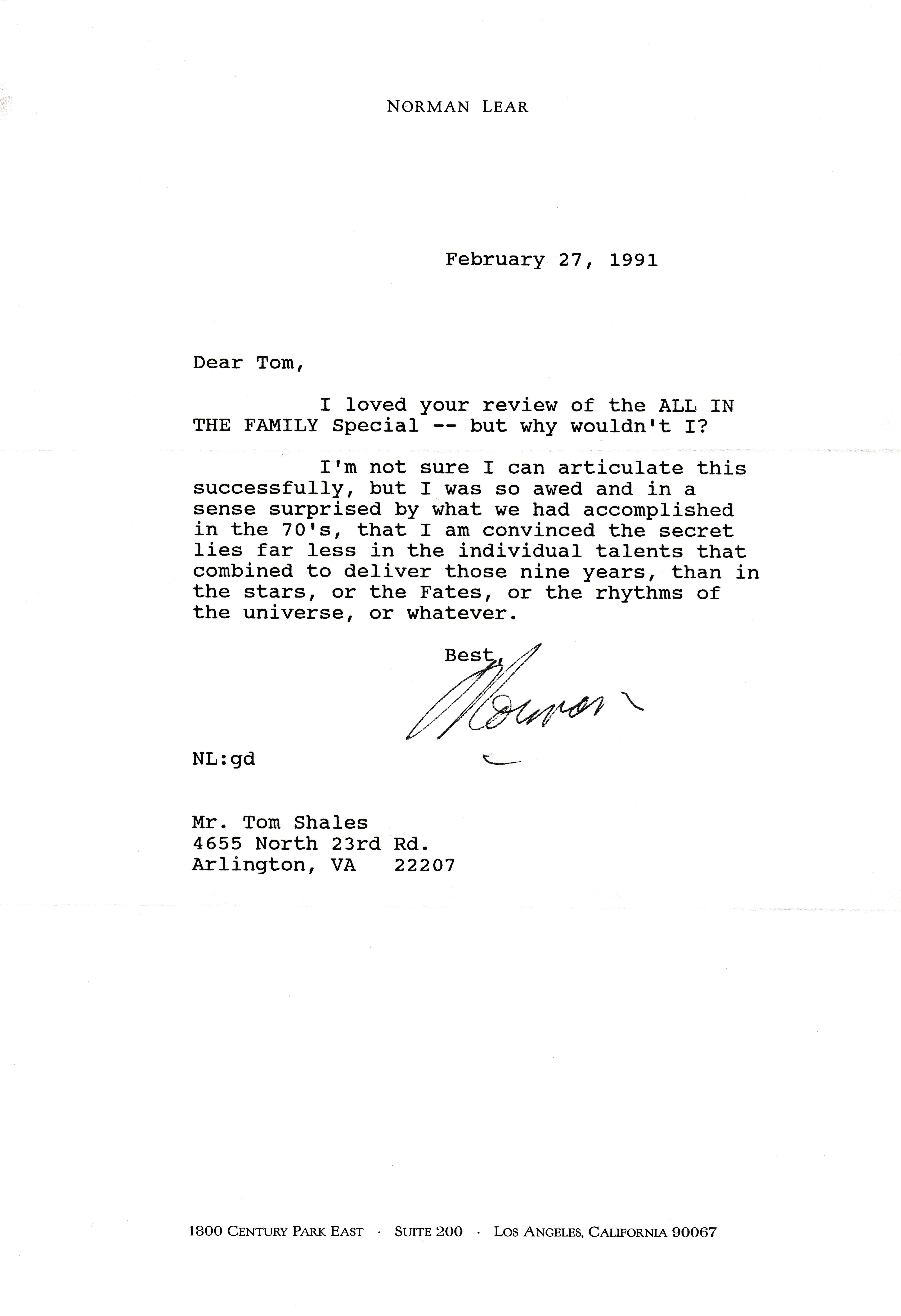
Here is the second letter from a small archive of noted TV columnist Tom Shales, that I recently acquired. Here, Norman Lear commends Shales for his review of an All In The Family 20th Anniversary special which aired on CBS the night before, on 2/16/91. A remarkable letter in which one of TV’s most important creators reflects on his most iconic creation.
This week’s historical Variety issue comes from 11/24/87


War And Remembrance: The main TV cover story is about ABC and its $100M investment in the mini-series War and Remembrance. At this point in time, the sequel to the incredibly successful Winds of War, which had a 50+ share, was still in post-production with open questions of length, scheduling strategy, and airdate. Producer Dan Curtis said, “You’re certainly not going to see anything until Fall 1988 at the earliest. The scheduling thinking is that the audience is not only going to many different channels, but the audience that sticks with the networks has become more impatient and won’t sit still for any kind of lengthy commitment.” Even as far back as 1987, the industry was discussing how the networks were losing audience.
Ultimately, War and Remembrance ran for 30 hours but only drew a 25 share and marked the start of the end of the lavish mini-series on Broadcast. The audience fragmentation that was happening due to cable’s growth was starting to take its toll.
Today’s Relevance: While network spending on lavish scripted events declined after the failure of War and Remembrance, the topic has become hot once again in the last few years as spending has reached similar heights with SVOD shows as The Rings of Power and Severance, and every long-running Broadcast drama which has to trim costs through cast reduction (Dick Wolf universe) or salary cuts (Blue Bloods).
Glaring Variety Mistake: In the article about CBS’s mid-season schedule, Simon & Simon is listed as a new show for December 1987, replacing Wiseguy on Thursdays at 9pm. While Simon & Simon did go into that slot, it had already been on the air for six seasons; 87/88 was season number seven. This is a highly unusual mistake for the “industry bible” to make.
Today’s Relevance: Despite this rare error, in the 1980s a trade publication like Variety featured expertise in analyzing the performance of television shows since Nielsen ratings were quite straightforward. However, most analyses today of streaming ratings are faulty. They use weekly top ten rankings and call things “hits” when they are not. They often seem like network puff pieces. Here is a new example about My Life With The Walter Boys, which was very strong in S1 but dropped a lot in S2, which is not addressed, indicating a poor understanding of how to interpret the data.


Peoplemeters: In 1987, Nielsen began the phase-out of measurement by written diary when it introduced home devices that allowed panel members to push a button to represent who was watching TV in order to determine age, gender, and other demographics more efficiently and accurately. One of the concerns was that this new technology would change demo ratings so much that the whole system would be out of whack.
The article here covers the fact that, actually, the transition was smooth. “After eight weeks of the 1987-88 season, no drastic change is apparent — at least not yet. Granted, peoplemeter results provide speedier delivery of demographic information that used to take two weeks to arrive. Other than the speedy delivery, there is little sign that demographics (rather than Household ratings) have caused any program changes or changed any selling or buying patterns… Nobody, however, doesn’t think that it won’t have its impact down the line somewhere, perhaps as early as the end of the first quarter of 1988, and probably by the end of the ‘regular season’.” Ultimately, the Peoplemeter ushered in a modern era of TV ratings.
The article is accompanied by a table that contains the HH rankings along with the male and female ranks for 18-34 and 18-49 for all shows. The goal was to see how different the demo ranks were compared to the HH rank. While some shows should have a large discrepancy because of their younger or older appeal, others should not, and the goal was to see if anything looked off. There are big ranking gaps between HH and demos for such shows as The Golden Girls, 60 Minutes, and Murder She Wrote, and the article points out how these make sense, but there were no major outliers, indicating the Peoplemeter was working.
Today’s Relevance: The industry just went through a similar change with the transition to “Big Data” for Nielsen’s measurement currency, which was also relatively problem-free after a one-year delay and a lot of scrutiny.
CBS’s Lack of Programming Strategy: In the Fall of 1987, CBS/s new president Kim LeMasters (not to be confused with journalist Kim Masters) had just been installed, and the network was in a distant third place. He admitted that two months into the season, CBS “has not had a great season so far”. Today, we think of 1987 as one of the golden eras of Broadcast TV, but LeMasters said, “The fragmentation of the audience to pay-tv and other media has reduced the ability of a network to manufacture a hit. You can’t take the time to build, as you did formerly. It now requires extreme patience.”
He seems to blame the lack of enthusiasm of the actors on his shows for the bad season, as he notes that on Hawaii 5-0, which had ended seven years prior, “Jack Lord would perform with such enthusiasm you could tell he thought that was the best show in the world and that the same thing applies to The A-Team on NBC”. He does not articulate any clear strategy to turn things around and resigned two years later.
Today’s Relevance: Broadcast scheduling strategies actually are not very relevant anymore. Ratings are too homogenized; most shows are part of franchises and perform similarly no matter where they air; rankings don’t matter; and so much of a show’s audience comes from next-day streaming, which is not publicly released.


NBC Wants To Invest in TBS: NBC, owned by GE, was looking to invest in cable networks in the late 1980s and TBS was one of their top targets. TNT was not in existence yet, as Variety notes that “Turner’s new channel is struggling to find support from the cable industry… cable system operators have expressed concern TNT would not be able to provide enough original programming to be a success.” Of course, NBC would eventually be heavily invested in cable, but not with TBS. TNT would indeed provide enough original programming.
Today’s Relevance: Cable was the streaming technology of its time, and the legacy Broadcast networks wanted to diversify their “traditional” businesses to keep up with where the viewer was going. We are in that same place forty years later.
Weekly Ratings: The ratings chart is for the middle of the November sweep, when sweeps still mattered. Of particular note, this was the first Fall for Fox Primetime, but the network was not included in the ratings report.
People today might think ALF on NBC was a joke, but it was really popular with a 19.7 rating and was the #1 series telecast on Monday. It led into a two-part TV-movie about Barbara Hutton, which also did well, but I suspect today most people don’t recall who she is (click her name to learn more).
Thirtysomething was a cultural phenomenon in the late 1980s, but its strength was in the demos which were starting to become more important at this time due to the aforementioned Peoplemeter. In the ratings ranker, the show looks like a weak spot with a HH rating of 11.6, -40% vs. the Moonlighting lead-in. However, in the HH vs demo ranker examined earlier, we can see that Thirtysomething ranked #36 in HHs but was #10 F18-34 because it had such a specific target.
While ABC’s The Rookie has become a big success over the last eight years, CBS failed with a similarish series, The Oldest Rookie. That starred Paul Sorvino as a 50-year-old street cop, but he clearly lacked the star power of Nathan Fillion. It was one of the lowest-rated shows of the week with a 9.8 rating and lasted only four months. Here are the opening titles.
The Cosby Show continued to reign supreme in 1987 with a 31 rating, the only show over a 30. All the following NBC shows — A Different World, Cheers, Night Court, and LA Law - were over a 20. ABC really struggled on Thursdays in the 1980s; CBS at least had Knots Landing.
Miami Vice at 9pm on Fridays was still cooking, but NBC was struggling to find a partner as Private Eye declined -42% at 10pm. Dallas and Falcon Crest were strong Friday performers.
NBC was Saturday’s juggernaut, with Golden Girls the tent pole at a 21.7 rating, while CBS was Sunday’s via 60 Minutes, Murder She Wrote, and The Gambler III.
Today’s Relevance: None. In this chart, there is a 25-point HH range between the first and last show. In 2026, the gap is less than ten points, excluding sports telecasts, so these sorts of tables do not really matter anymore. Linear ratings are a small factor in renewal decisions.
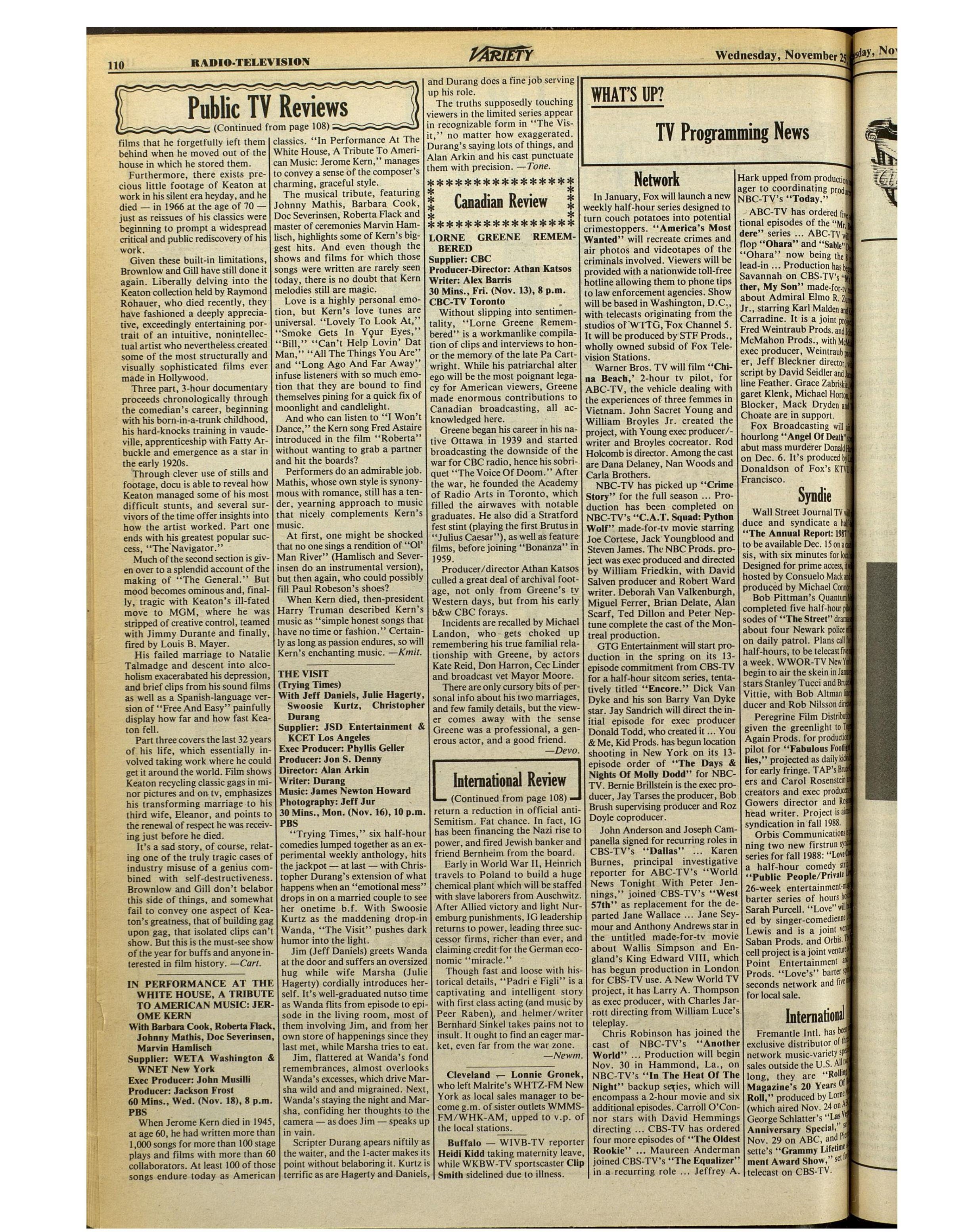
In the TV Programming News section, we see what are perhaps the first mentions of America’s Most Wanted, China Beach, and In The Heat Of The Night, important shows of the era which still resonate today.