"Previously On..."
A recurring look at recent TV I've watched, notable industry news, items from my archive & their significance, and the history of TV programming as told through the pages of TV Guide or Variety.


Disneyland Handcrafted (Disney+ / YouTube): There have been many documentaries about Disney theme parks but this is unique. No talking heads, no annoying experts, no discussions of the pros and cons of the company. Just 1 hour and 20 minutes of never-before-seen color footage of artists, engineers and craftsmen building the park in the 12 months before opening (mostly men but a few women are seen). Clearly all OSHA rules were being ignored, if there were any at the time. There is audio-only narration via archival recordings from many of the key architects and Disney legends who designed the park This documentary is available for free on YouTube here.
The Rip (Netflix): I enjoyed this original movie starring Matt Damon and Ben Affleck while I was watching it as it has some good action scenes, some tense moments, a few nice twists and ultimately a feel good ending. There were some logic holes although I cannot recall them now and that is symptomatic of the biggest problem with the film. Like most original streaming movies it was instantly forgettable. For a film with two big stars it felt small and unimportant. This raises a fundamental question about movies today - would The Rip have felt more important and grander if I had seen it in a theater instead of at home? I think the answer is yes. There is something about seeing a film in a theater, because of the effort and expense involved for the audience member that makes a more lasting impression.
Steal (Amazon): A six-part financial thriller starring Game of Thrones’ Sophie Turner as an employee at a financial firm who survives an armed robbery in her office. There are various twists and turns which are fine but not necessarily novel or exciting. Keeping the story to only six episodes was a smart move - any more and it would have become a slog.
Best Medicine (Fox): In the Fall I binged all 10 seasons of the charming British series Doc Martin. This is the American adaptation of the show with Josh Charles taking on the title role from the wonderful Martin Clunes (who will play Charles’ father in the Fox version). The pilot episode is a virtual remake of the UK pilot and Charles is doing his best to bring Clunes’ style to the character but, at least early on, he just does not have the same “x-factor” that enabled the original to sparkle. But much like Steve Carell eventually settled into the U.S. version of The Office, Charles could do the same in Best Medicine over time.
Star Trek: Starfleet Academy (Par+): As many readers may know I am a big Star Trek fan, especially the original series and Deep Space Nine. The multiple original Paramount+ Star Trek series have been, on the whole, disappointing with a few bright spots in the mix (Picard S3). So far Starfleet Academy is just OK. There are some fun moments, good action, solid special effects, and plenty of Easter Eggs. The biggest disappointment is that the show is set in the same world in which Star Trek: Discovery ended - a future far ahead of other Star Treks which I find to be dull and not part of canon. I will keep watching and hope for an engaging storyline to make me forget the setting.
Hijack (Apple): The story of the first season of the Idris Elba thriller was fun but completely illogical. With some skepticism I started S2 which is set on a train in Berlin. Spoiler ahead: I was going to turn it off when I discovered that Elba’s character Sam Nelson was the hijacker this time which was an interesting twist. I am curious to find out why.
Tell Me Lies (Hulu): The college drama gets nastier and puts our characters through even more trauma in season three - and that makes for compelling TV.
Supervillians on Procedurals: This is not a TV show review but a commentary on an annoying trend in current Broadcast crime dramas, particularly on ABC. A slew of series that are set in what is supposed to be the real world feature bad guys who seemingly have powers that let them commit any crime at any time without anyone seeing them while overcoming all logistical challenges and the laws of time and space. They also always seem to escape custody. Yes, some of these heroes have their own skills, like Kaitlin Olson on High Potential, but the supervillains are far more ridiculous. The supervillian is a crutch that programs use when they cannot create reasonable antagonists week in and week out like Law & Order does. Here are the list of culprits:
Will Trent: The character played by Greg Germann who was involved in Trent’s early childhood and then was a serial killer and abductor. Every crime he committed was preposterous.
The Rookie: I have watched every episode of all eight seasons but this show has a bad track record using supervillains. Rosalind Dyer (played by the late, great Annie Wersching), Oscar Hutchinson, Monica Stevens, and Jason Wyler are the characters names for other readers who know this show.
The Hunting Party: Every episode is about a supervillain that escaped a prison explosion and somehow just go about their lives normally after. Fortunately they are caught by the end of the episode but the gimmick is getting tiring.
High Potential: Matthew Clark, the Gamemaker, from the end of S1 and start of S2, was an unnecessary addition to a show this early in its lifecycle. There is absolutely no way he could orchestrate his crimes which made these episodes laughable instead of engaging.
Plot Flaws: Speaking of procedurals, I struggle to enjoy them when there is an obvious plot hole or logic flaw and I will start listing them in this section. Here are two recent and egregious ones:
Chicago Fire: S14 E8, 1/7/2026: The beginning of the show featured the characters of Severide, our hero firefighter for 14 seasons, and Van Meter, a seasoned investigator in an apartment of a building that has been set fire by an arsonist. These two experts only detect a fire when they hear a smoke alarm and open the front door to see the flames at the doorstep. They should have smelled the smoke way before they heard the alarm!
Law & Order: SVU S27E11 1/22/12026: At the start of the episode two of our protagonists, Rollins and Carisi, are held at knifepoint in their apartment by a young man who makes demands. They manage to break free and Rollins shoots the perpetrator in the arm before he flees, drawing blood. Later, they are able to narrow down the list of suspects who are then interviewed by detectives who ask them for an alibi and a voice recording so Rollins and Carisi can hear if it is the man who attacked them. The cops should have been checking the suspects’ arms for a bullet wound!

Netflix Buying Competitive Streaming Originals: On top of the recent news that Amazon had sold a few of its older streaming originals to Netflix as part of its the James Bond library deal, Paramount has also struck a deal to sell Netflix Mayor of Kingstown as part of a larger group of shows including Matlock, King of Queens and Watson.
One of those Amazon shows, 11-22-63 which premiered a decade ago and is based on the Stephen King book, is currently the #6 show on Netflix for 2026 when looking at total minutes viewed. This indicates that a little progress has been made in the “off-net” marketplace for streaming originals which up to now have provided almost no value as library programming. However these deals also reveal how slow and small this progress will be because:
Netflix appears to be the only buyer
Only a handful of titles are selling and seemingly only as “tax on the deal” as part of the real reason for the sale (i.e., James Bond)
The streaming shows are lesser titles
Alex Delaware TV Series (Amazon): Prime continues to lock up all of the world’s best-selling crime writers as it now adds Jonathan Kellerman’s police psychiatrist into its development stable. It follows in the footsteps of Lord Of The Rings, Wheel Of Time, Reacher, Cross, The Terminal List, Bosch, Jack Ryan and the upcoming Scarpetta. Prime remains the only streamer with a clearly defined programming strategy.
The Rockford Files (NBC): This a tough show to reboot but NBC is trying it for a second time after a failed try in 2010 with Dermot Mulroney. I worked at NBCU at the time and while I did not get to see that pilot, the scuttlebut was that Mulroney just wasn’t achieving the right tone.
The reason I call this a tough reboot is because of that tone issue. Rockford’s success rested on the shoulders of James Garner’s style, charm and tone + creator Stephen Cannell’s unique take on the genre which is very hard to replicate. Here is a video of Cannell talking about the show’s origins and you will understand why this is a challenge.
Now to be fair, Universal / NBC has successfully rebooted two other shows where the lead was the key. 1) It got five seasons out of a Magnum remake although that was a very generic show. Two aspects making that show easier to reboot was 1) the Hawaiian setting was another star and 2) the tone of the scripts was not nearly as distinct as Rockford. The other show was, of course, The Office where it seemed hard to reinvent that fantastic British cast.
One of the reasons Universal finds itself in this position is because it has the least rebootable TV library out of all the major studios. Paramount, Warner, Sony (Columbia), Disney (+ Fox) have hundreds of series dating back to the 1950s that have either become franchises, are iconic, or are simple formats. MCA/Universal in the 1960s-2000s created shows that were more character driven and did not repeat well. Fewer procedurals and multi-cam sitcom are other factors.
CBS Renewals: In my opinion CBS is the best positioned network for the future of Broadcast TV from an entertainment POV and the recent renewal of 10 series is strong evidence. It’s not the action of the renewals per se but rather the confidence in the performance and the financials to know this early that The Amazing Race, Elsbeth, Fire Country, Georgie & Mandy’s First Marriage, Matlock, NCIS, NCIS: Origins, NCIS: Sydney, Survivor and Tracker should all return. And this is on top of S2 orders for Boston Blue and Sheriff Country earlier.
As Broadcast continues to age up and be a destination for those seeking comfortable & known shows, the strength and mix of CBS’s roster best in class. It has a smart mix of diversified franchises (i.e. not all from one showrunner), series and formats that are proven repeaters which will serve Par+ and studio sales well, and is continuing to develop new series with excellent spin-off potential i.e. Fire Country (already demonstrated) and Tracker (that has to be coming).
In 1964 Ed Sullivan had a top 15 TV program and was a powerful media personality. In this letter he is writing to the famed NY Post columnist Leonard Lyons about another columnist, Jack O’Brian, who worked for the New York Journal American which folded just two years later in 1966. Apparently, Mr. O’Brian wrote a column (which I cannot find online) on 9/14/64 that suggested a producer of the then very popular Perry Como show was fired from the Ed Sullivan show for “family reasons”
This allegation clearly enrages Sullivan which led to this missive where he calls O’Brian “my bitchy friend” and includes proof that the parting was amicable. He quotes from the producer’s resignation letter that mentions his devotion to Sullivan, that he is leaving due to ill health, and that he is “eternally grateful for all the wonderful things that have happened to me during the last twelve years.”


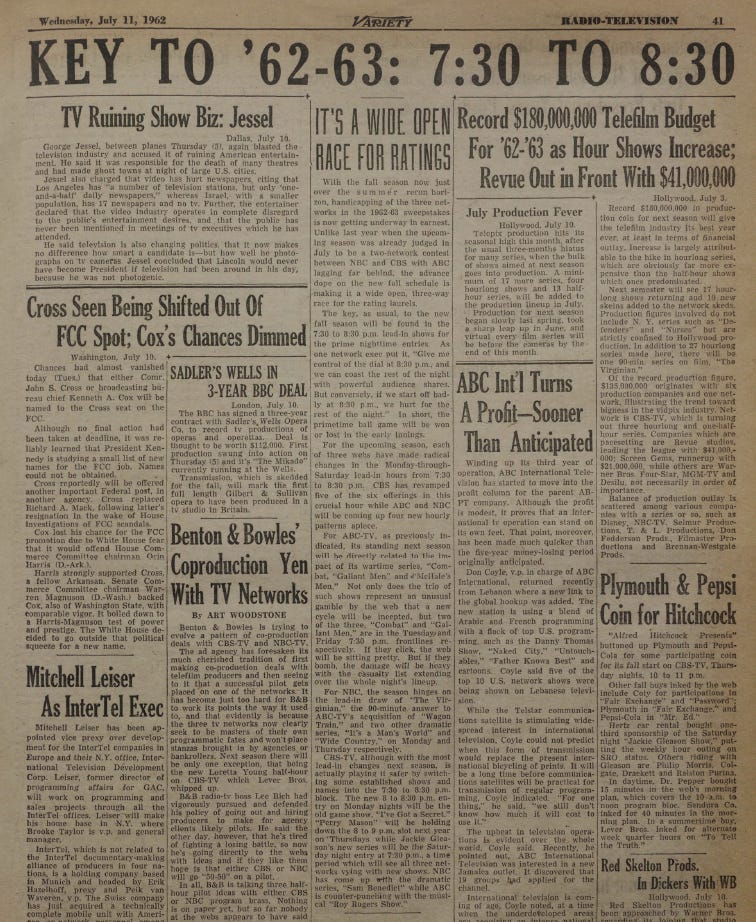
This week’s deep dive into the Variety archives comes from July 11, 1962.
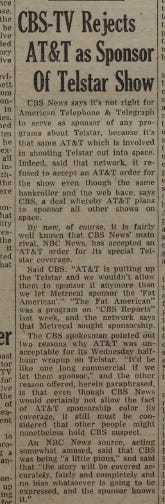
With CBS News currently in the spotlight, this article focuses on a situation where that organization refused a sponsorship for ethical reasons. Additionally, it centered around a critical evolution in global communications.
Telstar 1 was the first satellite to enable live broadcast transmission between the U.S. and Europe. It was manufactured by AT&T and launched by NASA on 7/10/62, just one day before publications date, but failed in Feb. 1963.
AT&T wanted to sponsor any of CBS’s news programs that covered the Telstar satellite, a major story of the time, but CBS rejected that saying, “It’d be like one long commercial if we let them sponsor” and even though the network would never allow that “other people might nonetheless hold CBS suspect.”
On top of all of this, NBC had already announced that it would allow AT&T to sponsor their coverage of Telstar. Upon hearing about CBS’s refusal, NBC said that the rival network was “being a little pious and that the story will be covered accurately, fairly and completely, and no bias whatsoever is going to be expressed, and the sponsor knows it.
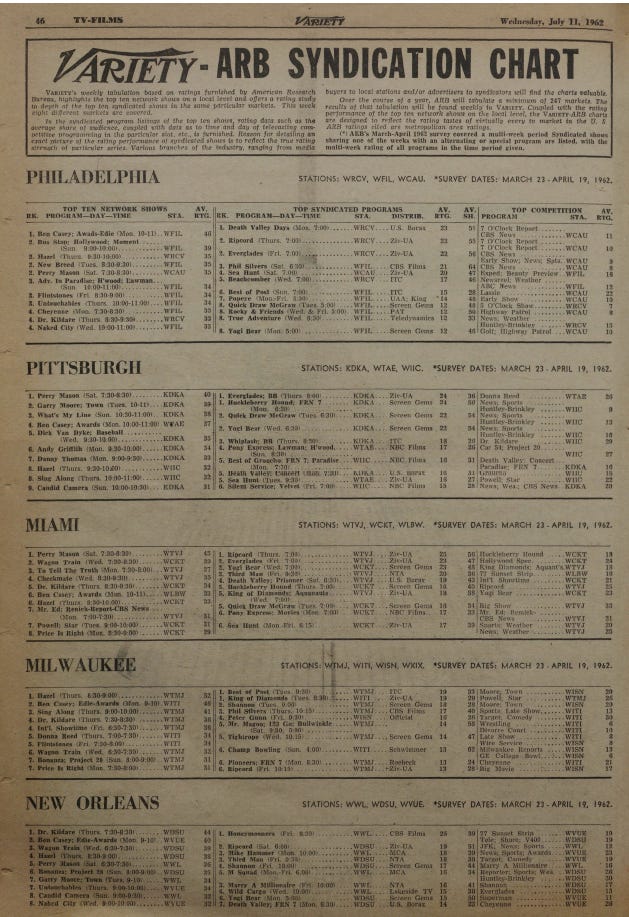
Back in the 1960s there were more ratings services than just Nielsen and one of those was the American Research Bureau (ARB) which became Arbitron which was eventually bought by Nielsen.
This chart is quite detailed as it provides the top ten series in five major markets (the article says eight markets but I only found five) for Broadcast Networks, syndication, and the top competition for the syndicated shows.
There is only a little consistency among the network series by market. Ben Casey, a medical drama, was #1 in Philadelphia; Perry Mason was on top in Pittsburgh and Miami; the sitcom Hazel was #1 in Milwaukee; and another medical one-hour, Dr. Kildare, won the gold in New Orleans. Ben Casey is the only show to appear in all five markets while a few others only appear in one market.
The syndication ranks are a mix of network reruns and first-run series from the era (Peter Gunn, Death Valley Days, Ripcord). I am surprised that some reruns of hit Broadcast shows that were in the marketplace at the time did not make the syndication top ten such as I Love Lucy, Perry Mason and Dragnet.
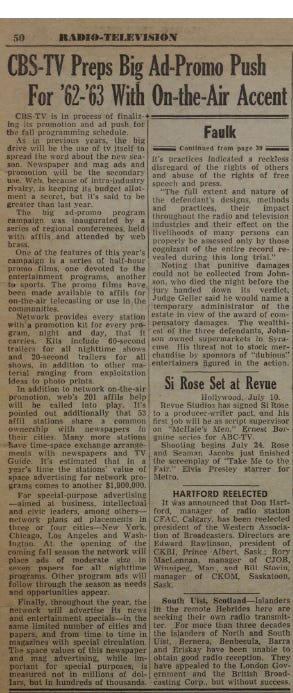
In 1962 TV was still a relatively new invention; it had been less than ten years since more than half the country owned a set. The topic of this article is how CBS plans to use its own air as the main way to promote its 1962/63 schedule instead of newspapers and magazines which were the common methods to advertise at the time. This article may represent an inflection point where the TV industry realized it had become more powerful than the media that came before it.
The final article of interest is an analysis of the upcoming 1962/63 TV season. Before the Prime Time Access Rule went into effect in 1971, the Primetime schedule started at 7:30pm instead of 8pm and, per Variety here, the 7:30p-8:30p hour of Prime will decide who wins the season because it’s the lead-in for the rest of the night.
An anonymous network executive is quoted as saying “Give me the control of the dial at 8:30pm and we can coast the rest of the night with powerful audience shares. But conversely if we start off badly at 8:30pm, we hurt for the rest of the night.”
Furthering the focus on this hour is that the networks had reshuffled the programming there extensively for Monday-Saturday. CBS was planning to change five of the six nights and ABC/NBC four of the six.
From 7:30-8:30p ABC was leaning on WWII series that were modestly successful; NBC counted on the new show The VIrginian which would become a big hit, and two dramas that failed; CBS was relying on established shows such as Perry Mason and I’ve Got A Secret.
In the end CBS easily won the 62/63 season.