"Previously On..."
A recurring look at recent TV I've watched, notable industry news, items from my archive & their significance, and the history of TV programming as told through the pages of Variety.


I have started to write articles about the business of television for Forbes. My first two articles are about Netflix content performance in 2025 and the future of syndicated TV talk shows.

Paradise (Hulu): I enjoyed S1 because it was a utopian look at a dystopian world. I was concerned that S2 would become just another Walking Dead clone minus the zombies since Sterling K. Brown went to the surface in the finale. Not only did this happen, but the end of episode three was SO STUPID that I have given up completely. I am going to spoil that in the next paragraph, so skip if that is a problem.
At the end of the episode the female secret service agent who is also a raging assassin that no one can seem to be able to catch, slits the throat of the new President out in the open under a streetlamp and then manages to frame a good female secret service agent by knocking her out after choking for her from behind for three seconds and then putting the knife in her hand. It was almost as fast as a Vulcan neck pinch from Spock. The fact that the trained secret service agent could not fight back against her scrawny assailant, even if she was also a trained agent, is incredibly lazy writing. It also looked very fake on-screen. What a massive drop in story quality over the course of a season.
CIA (CBS): This new series in the FBI franchise replaced Most Wanted and International, two shows that I enjoyed. So far, it’s pretty by the numbers, which is all it needs to be. I was never a big fan of Nick Gehlfuss as Dr. Halstead on Chicago Med, and I feel the same way about him here as an FBI agent, although he serves the role adequately. Tom Ellis is also serviceable as his CIA partner. I’ve never quite understood the appeal, but I suspect his fan base is mostly female. Ellis was also the star of Rush, a one-season USA Network series that aired during my tenure there as head of Research. Rush was an early venture in our pivot away from Characters Welcome towards darker-themed programming after The Walking Dead ushered in a new blueprint for cable scripted storytelling. We pivoted too far.
The Night Agent (Netflix): The first season of this action show was quite engrossing, even if it was a bit dopey. Season two was a hot mess with an implausible terrorism storyline. Season three is in between the two, with a more novel plot, although I cannot recall what happened now that it’s been two weeks since I watched it. Something involving the U.S. President and a cover-up and assassins. It’s an easy binge on a weekend, but more as a companion to other activities than a lean-forward experience.
56 Days (Amazon): A six-episode thriller about two twenty-somethings who seemingly have a “meet-cute” in Boston but actually have many secrets to hide from each other. The reveals play out well enough, and the leads have decent chemistry, but it’s also mostly forgettable.
The Last Thing He Told Me (Apple): I had forgotten about S1 of this thriller series starring Jennifer Garner, which I enjoyed in 2023, so I was happy to find that S2 is now available. The general plot is that Garner’s husband disappears to hide from the mob, and she ends up on the run with her step-daughter in tow. I have watched three episodes so far. The first two move fast, but the third one slows down for some drawn-out character development and some cliché mistakes involving the use of cell phones that can be tracked by the bad guys.
Scrubs (ABC): I was a regular, but not a devoted, Scrubs viewer during its original run. The reboot has not lost its step as the chemistry of the original cast and the snappy, irreverent, cut-away writing style are all still intact. This will become only the second live-action Broadcast comedy I watch each week, alongside Abbott Elementary.
Survivor (CBS): I vividly remember the phenomenon that was S1 in the Summer of 2000. I even had a viewing party for the finale, the type of event I generally dislike, let alone host. Here we are more than 25 years later, with the 50th season now on the air, featuring cast members from prior years. Many people do not realize that it is still one of Broadcast TV’s top shows on P18-49, and, in some weeks, the #1 show in that demo on linear. The reason for that is simple - a great format that is produced with exquisite care and casting.
Summer House (Bravo): I have watched for all ten seasons, but the only interesting thing left to watch is the tension between OGs Kyle and Amanda. If they leave and all we have left are the endless, soporific costume parties and boring new housemates, I will give it up. But I am looking forward to the upcoming spin-off, In The City.
Marshals (CBS): Kudos to CBS for finding a clever way to extend the Yellowstone franchise to broadcast, which has paid off very well. As for the show itself, even though three characters from Yellowstone came over, including series lead Kayce Dutton, and a major off-screen death is revealed in the pilot, Marshals doesn’t really feel like “Yellowstone”. This is not necessarily a bad thing, as it is a solid CBS procedural, but those who sampled the pilot to get a fresh dose of the IP may tune out over the first few weeks once they realize it is not what they were looking for.
RJ Decker (ABC): This is essentially a Rockford Files reboot before NBC has even had a chance to make its pilot. Scott Speedman plays the title role as a down-on-his-luck ex-con who was framed and has now become a private eye and lives in a trailer park in Florida. Here is the official description of The Rockford Files from Wikipedia:
James Scott "Jim" Rockford had served time in California's San Quentin Prison in the 1960s due to a wrongful conviction. After five years, he was pardoned. His work as a private investigator barely allows him to maintain his weathered mobile home (which doubles as his office) in a parking lot on a beach in Malibu, California.
Speedman is a strong lead with the right tone, which I also expect from David Boreanaz in the NBC pilot. The plot of the first episode is a bit convoluted and rushed, but I will try a few more. The series wants the Florida setting to be another star, much like New York City for Law & Order, but it does not really contribute that much.
Unfortunately, the pilot does employ the trope of introducing supporting characters by having Decker engage each of them in forced, witty repartee while they unnecessarily address each other by name and state their relationship to each other (“You’re the dumbest ex-husband I’ve ever had”). The audience can figure out who is who without being treated like morons.
DTF: St. Louis (HBO): An odd comedy-drama starring Jason Bateman and David Harbour as unsatisfied husbands who discover a sex app in their hometown of St.Louis, which eventually leads to a murder as revealed at the end of episode 1. It’s a quirky show that could be an enjoyable ride.


The X-Files (Hulu): Disney is finally taking a significant step to thoughtfully mine the TV IP it acquired in its purchase of 20th Century Fox by ordering a pilot for a new X-Files series. This one will feature a diverse cast and will be written and directed by Ryan Coogler, who has now become a brand name from the theatrical success of Sinners. It’s not the first The X-Files extension. There were two theatrical films, the TV spin-off The Lone Gunmen, comic books, and a two-season revival series in 2016 and 2018. But this is the first to put the IP in another person’s hands other than creator Chris Carter, with characters and actors unrelated to the original series. I smell success.
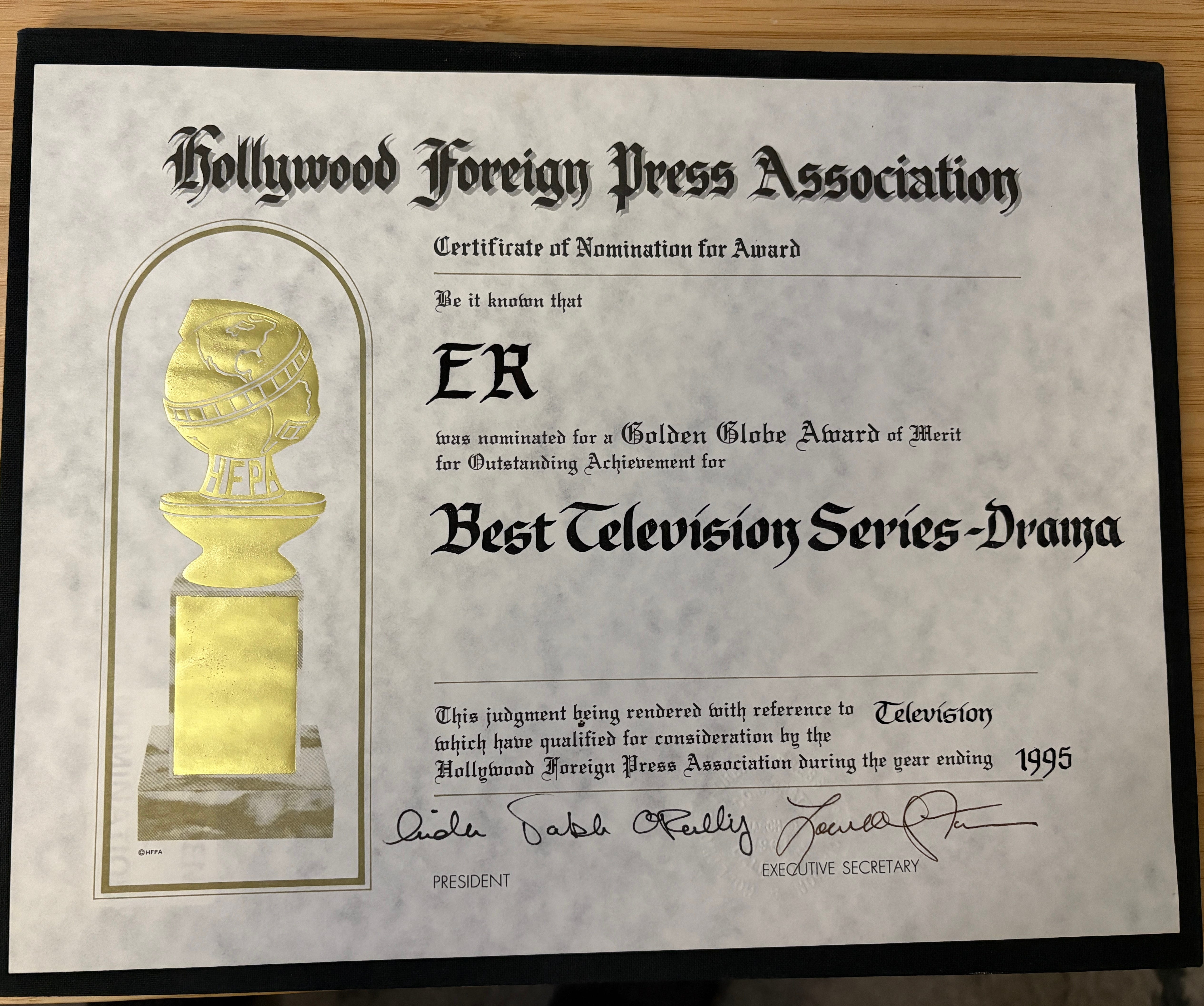
In honor of The Pitt and to showcase some new acquisitions, here are two historical items celebrating the mammoth success of ER during its original run:
Official Golden Globe nomination certificate from season one.
A Tiffany paperweight sent out by Warner Bros. to key stakeholders to celebrate the show’s 100th episode, which aired in 1998.

This week’s deep dive into the Variety archives comes from April 30, 1980.

The TV section for this edition starts with an article about a prescient speech from Norman Lear given at the Kansas City Chamber of Commerce. He asserts that the networks’ obsession with ratings is leading to a decrease in show quality, specifically comedy, and states that “The network may win, but the viewers, creativity, and controversy are the losers.” He is wrong about that, and without those ratings, there is no one to fund the production of any programming. Additionally, I would point to All In The Family as the biggest proof that quality and the chase for ratings can go hand in hand.
It is some later quotes where his visionary status is on display via discussions about new technologies, including cable and premium pay. “With the multiplicity of channels to be filled, I believe we will begin to hear from entrepreneurs countrywide, from people interested in the theatre from major cities, from ethnic groups and lifestyles that have never been represented on the tube before. There is the real excitement of the programming future… There is a danger that the home could become the ultimate cocoon, but we will face that danger down by harnessing the new technology to serve us, to educate us, and to sustain us.
I am a bit surprised ‘the ultimate cocoon” did not stick.
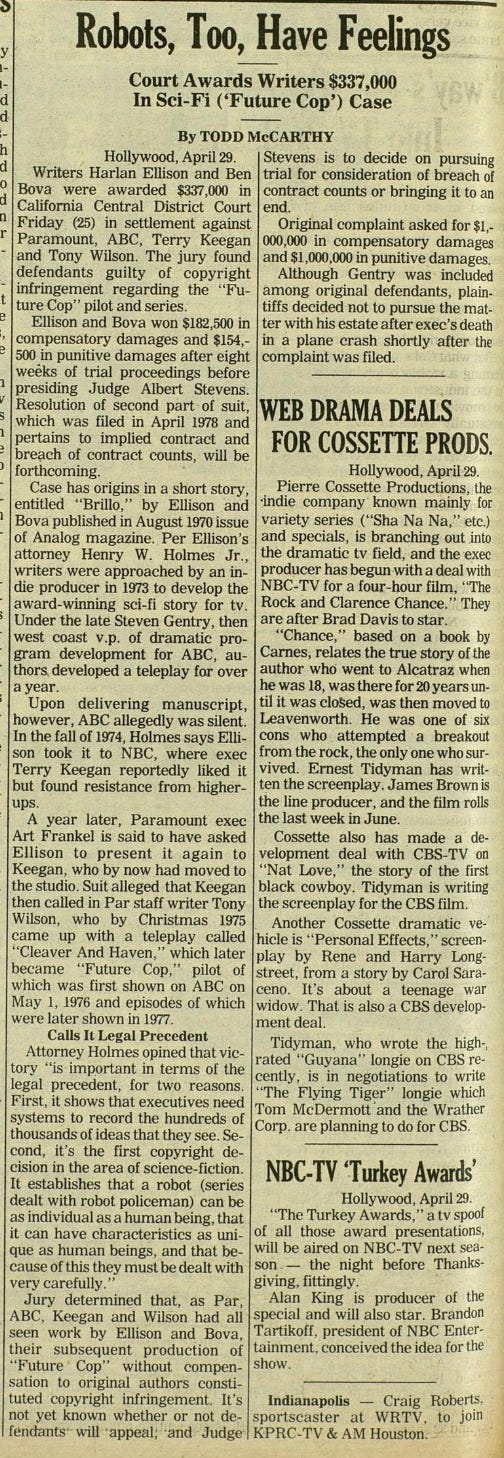
Future Cop was a failed and boring 1976 crime drama about two patrol officers played by Ernest Borgnine and an actor named Michael Shannon (not that one), but Shannon’s character was actually an android. You can watch the pilot below. More interesting than the series itself was the behind-the-scenes copyright drama. Two noted science fiction writers, Harlan Ellison and Ben Bova, sued ABC and Paramount, among others, claiming they created the show in 1973, and that executives at both of those companies read treatments and scripts. A jury agreed, and ultimately the writers received $337K, much lower than the $3M requested.


Two articles to highlight from these pages.
ABC’s 1980/81 Schedule
This was an era when ABC was very strong and virtually tied CBS for #1 in the prior season’s rankings. For the next season, three of the four new sitcoms that were introduced are still watched today: Bosom Buddies because of Tom Hanks and Peter Scolari; Too Close For Comfort, which had a six-season run, three on ABC and three in first-run syndication; and It’s Living, which also ran for six seasons on ABC and in syndication. The fourth was called I’m A Big Girl Now starring Diana Canova, Martin Short, and Danny Thomas. Here is that show’s opening title. It lasted only one year.
Other new programs included a failed drama starring Shaun Cassidy based on the bicycling movie Breaking Away, and Those Amazing Animals starring Burgess Meredith, a spin-off of That’s Incredible. Both failed.
Little did anyone know that this sentence from the Variety coverage would give ABC a #1 show and cultural sensation just a few years later “Dramatic shows were not over-looked by the web, as it has made commitments to three such series ('Oil," "Foul Play” and “The American Dream"), which will go into production for airing sometime during the coming season - and represent the web's bench for backup utilization.” Oil was the original title of Dynasty.
Among the notable shows that changed timeslots were Charlie’s Angels (heading into its final season), Taxi, Soap, and Benson.
The big theatrical movies for the season included Jaws 2, The Enforcer (Dirty Harry), The Spy Who Loved Me, and Saturday Night Fever.
The most prominent mini-series announced was Masada, which aired in April 1981 and averaged a 40 share across three nights.
The Press & The White House
You might think the current tension between the government and the news media about Iran is something unusual, but it’s not. The second article of note above is called, Has Anyone At The White House Read the First Amendment? It recounts a testy phone call between the head of NBC News, Bill Small, and Jimmy Carter’s White House Press Secretary Jody Powell. Small was annoyed that The White House wanted news organizations to tell the government every time they moved people in or out of Iran because of the Iranian hostage crisis and the failed rescue attempt two weeks prior. Violations of the rule could lead to ten years in jail and/or a $50K fine. Powell said, “not even Nixon and his crowd ever tried to pull anything like this.”
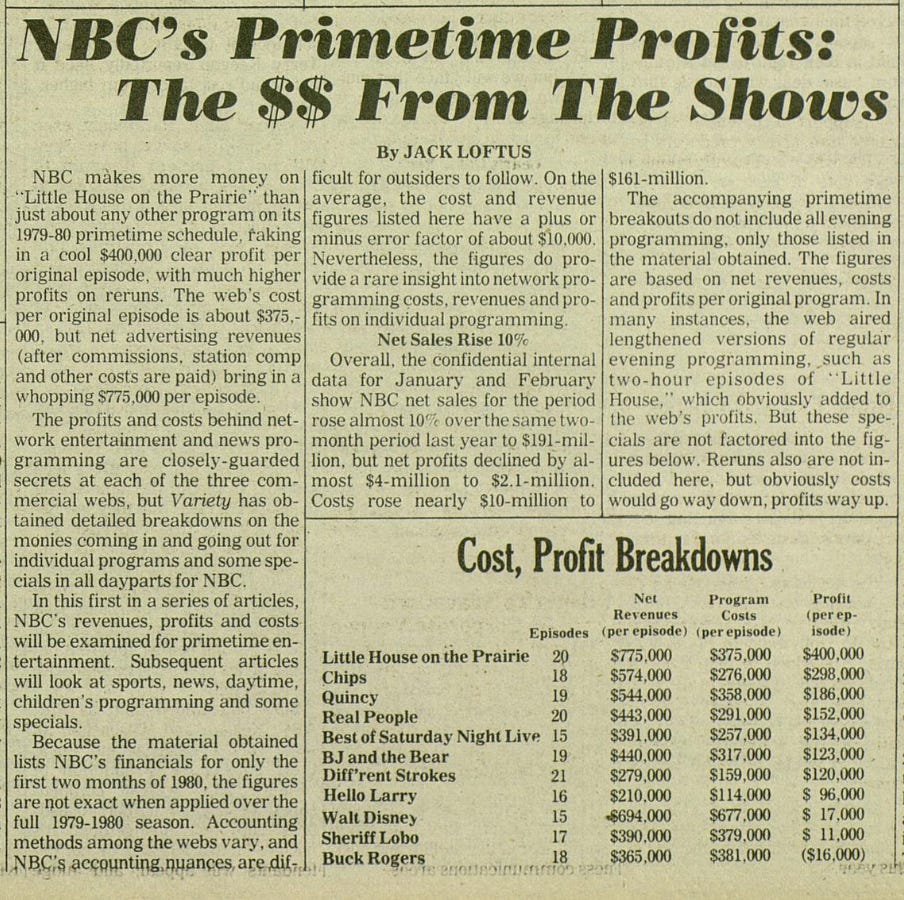
The above provides fascinating insight into the profit levels for hit TV series of the time, using NBC as a case study. Little House On The Prairie is in the spotlight today due to its success on SVOD and FAST and the upcoming Netflix reboot, which was just renewed for a second season before S1 has launched. In 1980, it was NBC’s most profitable program, earning $400K per episode ($1.55M today).
CHiPs was a distant second at $300K per episode, followed by Quincy ($186K) and Real People ($152K).
The most expensive program was Disney’s Wonderful World due to the license fees for the theatrical movies in the package. It also generated the most revenue
The least expensive title was the failed Diff’rent Strokes spin-off, the sitcom Hello Larry, which is synonymous with McLean Stevenson’s failed career after he left MASH. Real Housewife Kim Richards co-starred as well as Meadowlark Lemon as himself. A classic TV flop. Enjoy an episode below.
Buck Rogers was the only show on the list to lose money since it brought in relatively low ad revenue, but was also the most expensive series (Disney was a movie package).
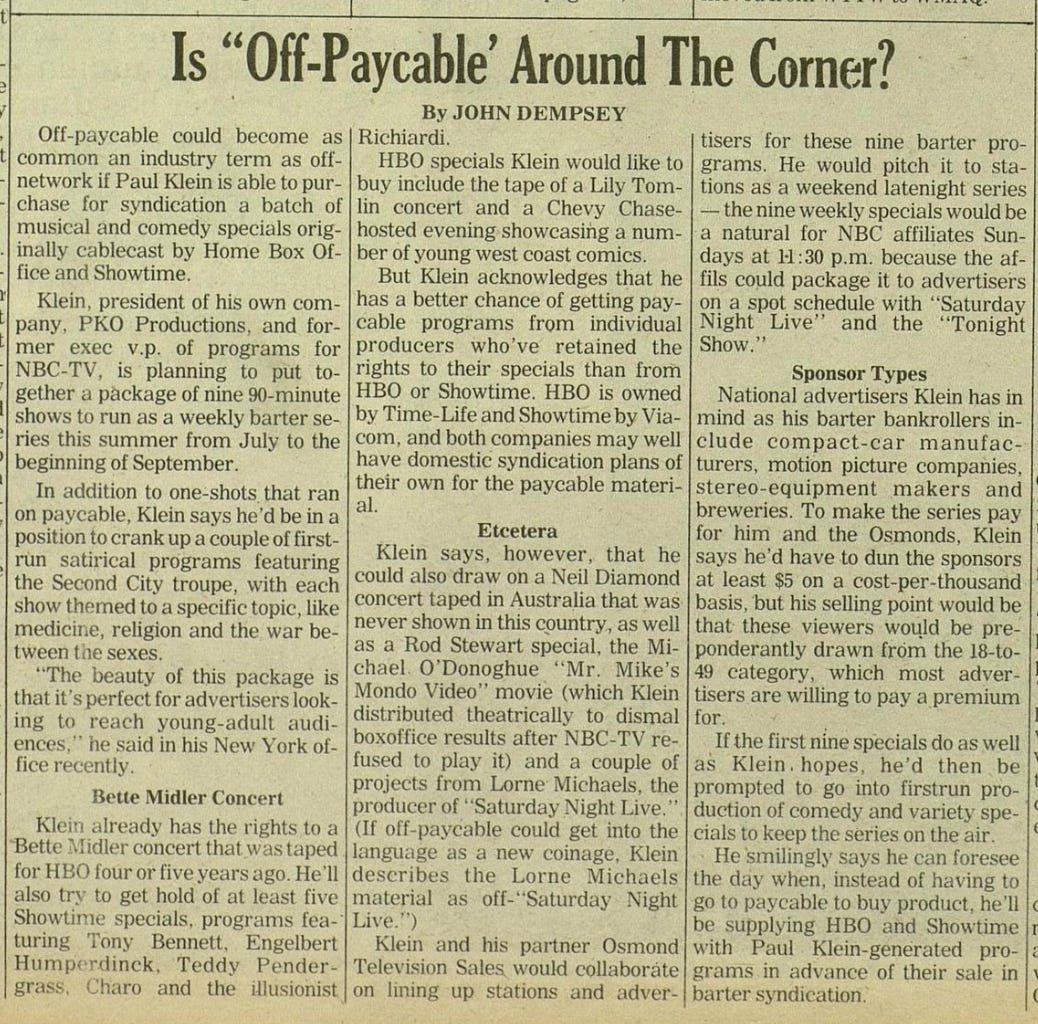
The biggest challenge facing television today is the low value of streaming originals in the library marketplace. Except for Sex & The City, no pay cable series has truly made a long-term mark in both the linear and streaming library marketplace, either. In 1980, original programming on HBO and Showtime consisted mostly of musical and comedy specials, which, according to the article above, were attempted to be sold into syndication by Paul Klein, an NBC Research exec and pioneer in the pay TV space. This did not become a particularly lucrative area of syndication.
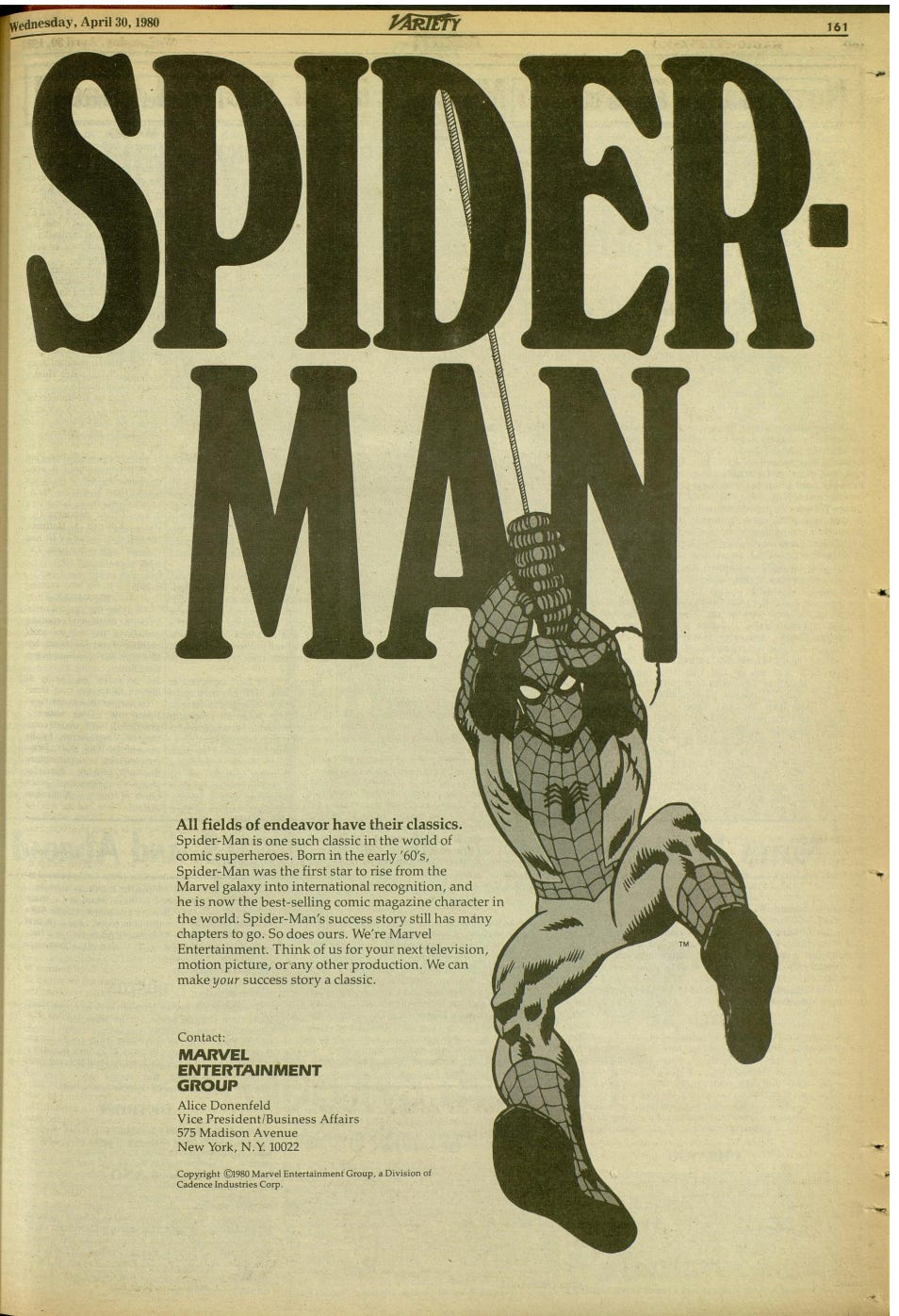
46 years ago, Marvel was an ignored IP and had to take out ads like this to tout its characters and its prowess. Spider-Man’s success story still has many chapters to go. So does ours. We’re Marvel Entertainment. Think of us for your next television, motion picture, or any other production. We can make your success story a classic.