"Previously On..."
A recurring look at recent TV I've watched, notable industry news, items from my archive & their significance, and the history of TV programming as told through the pages of Variety.


The Crash (Netflix): One of the most successful streaming shows of the year is also one of the most compelling and confounding. It covers the case of Mackenzie Shirilla, who was convicted of intentionally crashing her car into a wall, which killed both her boyfriend and a close friend. If you like true crime, this is an absorbing watch, like many docs in the genre, a tough one.
Spider Noir (Amazon): I really did want to like this show. A reimagined Spider-Man series set in 1930s NYC, filmed in black and white, sounded cool. When Nicolas Cage was cast, I was a bit baffled but also intrigued. When I found out that the series would be available in both color and B&W, I admired the innovative gimmick. I watched three episodes and tried both versions, but ultimately, the story was not very interesting, Cage felt out of place, and the episodes moved too slowly.
Criminal Minds: Evolution (Paramount Plus): The streaming revival of this show fell into one of the most prevalent traps that can undermine a TV crime drama - the supervillain who always outwits our heroes and never makes a mistake until a season or series finale. Since the first episode of Criminal Minds S16E1 / Criminal Minds: Evolution S1E1, Zach Gilford has played Elias Voit, aka Sicarius - a serial killer. This character is still on the show and a major presence, but, at least now in S4, he is behind bars, presumably reformed after a brain injury and helping the police. However, this show works best with a criminal who is caught or killed at the end of the episode - providing the satisfaction that procedural viewers crave. There are some serial killers of the week this season, so perhaps the show is getting back to basics.
Four Seasons (Netflix): I really enjoyed S2 and binged all eight episodes in about 24 hours. The cast, writing, and plotting were great, and the four hours went down like ice cream. There are some streaming shows that go on too long, but this one was too short.
Propeller One-Way Night Coach (Apple): While the acting in John Travolta’s short film based on his children’s story is mediocre, the 1950’s mid-century modern setting and love letter to the glory days of TWA make it a treat for those who revere those wistful days - even when we glorify them beyond reality.
Cape Fear (Apple): I have watched one episode of the third filmed version of the novel by John D. MacDonald. It was a bit melodramatic, and I am concerned that Javier Bardem’s Max Cady will become another super-villain as Cady was when Robert DeNiro played him in the 1991 film. I will give up if there are episodes when his menace could easily be thwarted.
Star City (Apple): This may be the first spin-off in TV history to tell the story of the parent series (For All Mankind) from an alternate POV (if you know of one I am missing, please let me know). Star City depicts how the USSR beat the USA to put a man on the moon from the POV of the Russian space program and its ruthless leaders. Unlike For All Mankind, there is no sense of awe or interesting twists on the real history of the 20th Century. Instead, it is more of an espionage story mixed with social commentary on Soviet barbarity. I am enjoying it, but it is not providing the same thrill that For All Mankind did in its early years.

Fox Buys Roku: Whether Fox paid $22B for Roku for the platform’s ad dollars or for the fact that 100M HHs use its devices to watch streaming TV, or both, the more existential topic this deal raises is how smaller media companies like Fox, NBCU, A&E, and AMC need to make a transformative deal or be sold in order to stay relevant and viable over the next ten years.
Fox was sitting on a lot of cash after the 20th studio sale to Disney and was waiting for the right way to spend it. It clearly was not going to buy a large content business since that 20th sale made it clear that IP ownership was not a priority. I do think that owning a leading streaming hub is the bigger win for Fox than the ad dollars. Fox realized it needed to make a big bet on streaming, where it lacks assets aside from AVOD with Tubi, and it chose to go the hardware route. All the deep analysis now is a little pointless, as it will take years to know if this purchase will pay off.
Netflix Renews The Four Seasons, Cancels The Boroughs: When data from Luminate and Netflix reveal that a series has notably low audience levels that is often followed, eventually, by a cancellation. This week, we have one instance where that holds true and one where it does not
The Boroughs: This article in The Hollywood Reporter gets the performance of the show all wrong. Most media reporters today really do not understand streaming ratings. Just because a show makes a top 10 streaming chart DOES NOT MEAN IT IS DOING WELL!! The Boroughs was not doing well, especially when considering The Duffer Brother expectations. The show ranks 51st out of all Netflix TV seasons released since 2025 based on Netflix’s self-reported global data, just ahead of Pulse S1, which was also cancelled. The article may be right that the show was too expensive, but that cost was exacerbated by the underperforming viewership. Don’t be fooled — the data predicted the cancellation.
The Four Seasons: Despite a massive decline in audience for S2, -58% after three weeks per Netflix global data, the show was renewed for a third season. My guess as to why is that Universal, the studio that produces it, wants an asset with three seasons, not two, so that it has some library value, and it gave Netflix attractive terms to pick it up. I do not believe there is some magic, advanced KPI in Netflix’s data that reveals the show is important for its business with less than half of the audience from S1.
The Media Doesn’t Know How To Use Data: Another Hollywood Reporter article that drove me crazy is about Apple’s Widow’s Bay and is pasted below (you can click on the image of the headline to read it). The gist of the piece comes after a narrative of its long road to get “on the air”: “Here we are in 2026, and the debut season of Widow’s Bay has emerged as something of a word-of-mouth phenomenon on Apple TV”. I don’t dispute that the show is successful, but the only evidence THR uses to support its claims of “phenomenon” is a few celebrities talking about it publicly. “Oscar winner Guillermo Del Toro recently posted that it “may very well be the best streaming series in a long time… and hands down one of the most mesmerizing acts of narrative prestidigitation in horror.” Ben Stiller has dubbed it “excellent.” Jonathan Bailey called it “incredible top-tier television.” The New York Times just named it the best new show of the year. These quotes have nothing to do with the civilian audience at large, just what four celebrities think about it. Celebrities are not particularly good predictors of mass market success across the vast swaths of America.
I don’t want to put all the blame on the trades. Because most streaming data is not available to reporters, or they do not want to / don’t know how to analyze what is available, they resort to making it up based on very little or no information. Before streaming, the rating for every show on linear TV was available and easily understood. This is why I started this Substack - to cut through the noise and provide clear analysis of streaming performance.

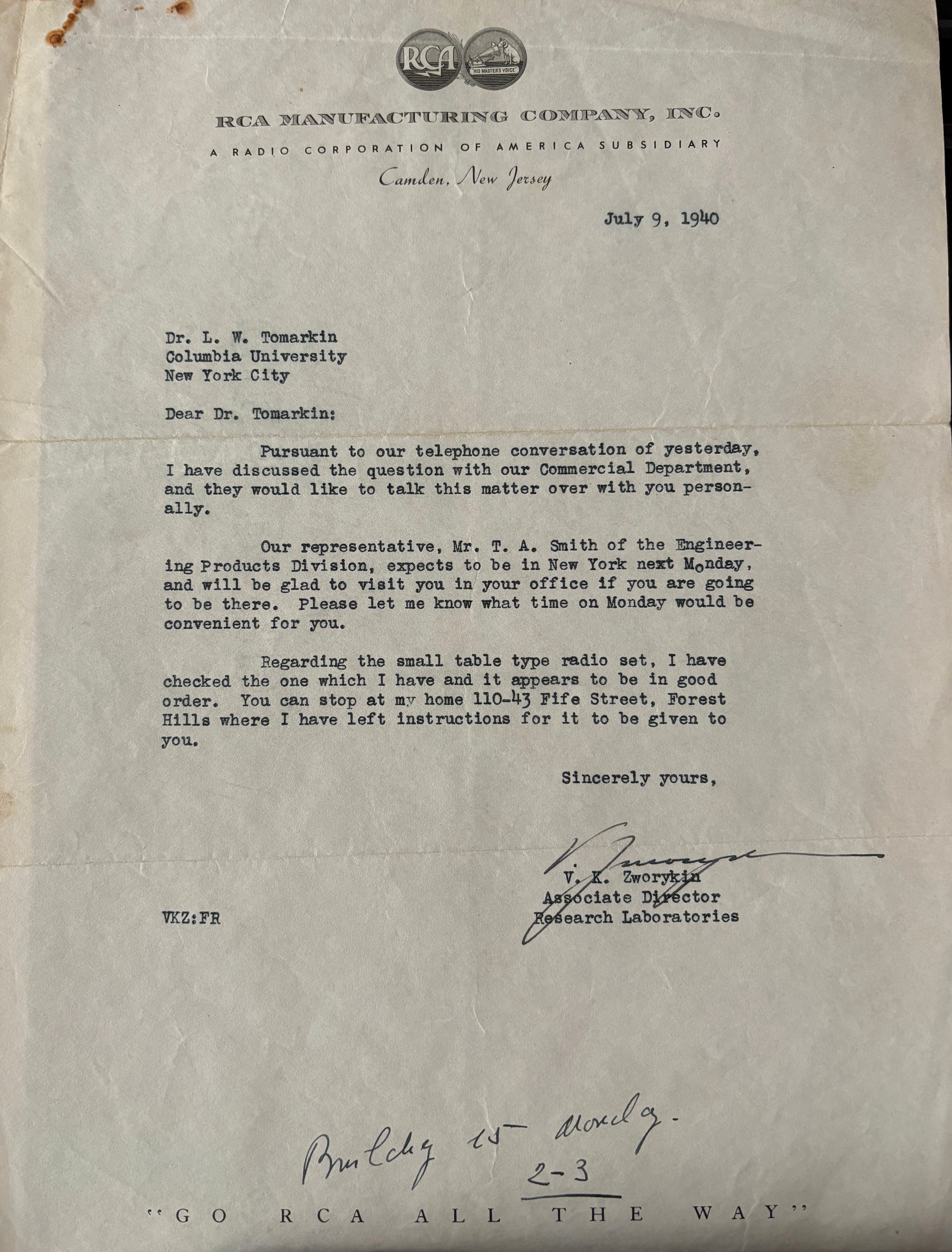
While Philo Farnsworth gets the majority of credit for inventing television, RCA engineer Vladimir Zworykin was a key part of the process because of his work perfecting cathode ray tubes as receivers. In this letter, written on RCA letterhead from Camden, New Jersey, which made a large portion of America’s TV sets in the 20th century, Zworykin writes to a professor at Columbia University. Zworykin letters are hard to find, so while the content in this letter is not revolutionary, any communication from him regarding technology is important
He appears to be trying to connect the professor with another area of RCA regarding an engineering topic of interest to both groups. He also discusses a radio set which he is giving to the professor. Zworykin tested radios for the Russian army during WWI, and of course, radio was the forerunner of television.
This week’s historical Variety issue comes from 11/30/66


In 1966, movies were a key element of network schedules, and in a foreshadowing of the eventual merger of NBC and Universal, the two companies, distinct at the time, were planning on renewing a deal for theatrical and made-for-TV movies (MFTVM). At the time, Universal was owned by MCA.
The prior deal was worth $66M, $680M today, and the new one was expected to top that. It called for 30 MFTVMs and, based on the terms of the old deal, one out of every three of those, i.e., ten in total, were obligated to go to series. This seems like a very high commitment, and there is no proof that this was adhered to.
1966 was just two years into the life of the made-for-TV movie on Broadcast and itwould last another 35-40 years. The article points out that all other studio packages were sold to CBS or ABC, making the MCA/Universal deal a must-have for NBC.
Today’s Relevance: NBC relied on Universal movies for its linear schedule in 1966, much as Peacock relies on Universal movies to drive subscriptions and viewing minutes in 2026.


There are a number of notable articles in this section.
Two articles focus on the high failure rate of the Fall 1966 TV season. One provides the sorry state of affairs in raw data, as more than 1/3 of the 33 new series that premiered this season were already cancelled by the end of November. ABC had cancelled seven, CBS four, and NBC two. The other goes deep into the fact that among these failures were shows from once-bankable talent, in front of and behind the camera. Among those known names failing were Garry Moore, Milton Berle, Imogene Coca, and producers Hubbel Robinson / Leonard Stern / Quinn Martin / Norman Felton / Sherwood Schwartz / Lee Rich. If you don’t know who those people are, look them up. The point of the article is summed up here: “The acute shortage of ‘hot’ programs makes program development tough on the network programming execs who have made a practice of picking shows not on their own merits but on the producer’s Nielsen credentials”.
Today’s Relevance: The opposite is happening now. Time-tested talent/IP like Dick Wolf, Ryan Murphy, Chuck Lorre, Tim Allen, Scrubs, Yellowstone, and NCIS are delivering new and ongoing series that are working very well on Broadcast. Because of the success of this IP, there are far fewer new Fall shows each season. In 26/27 there are only six.
In late night in 1967, CBS had planned to compete against Johnny Carson, who was four years into his 30-year run, and ABC’s upcoming Joey Bishop Show, which would have a two-year run and feature Regis Philbin as a sidekick. The article here announces that the plan was pushed to 1968. There is no speculation or rumor about who or what would fill the slot. Today’s Relevance: This bookends CBS’s forays into late-night. The plans were first discussed in the mid 1960s, didn’t get off the ground until Pat Sajak’s failed series in 1989, and ended sixty years after this article in 2026 with the final Stephen Colbert show.
There are two articles that discuss the pilot for the now-forgotten TV show The Name of the Game (the pilot was called Fame Is The Name Of The Game). That drama lasted three seasons, but it was the first in a long line of crime series that Universal made for NBC, including McCloud, Quincy, McMillan and Wife, and Columbo.
Today’s Relevance: The Name of the Game kicked off NBC’s reliance on Universal crime dramas throughout the 1970s. That reliance turned into a detriment as NBCU today has a TV library that is behind those of Warner or Paramount or Sony, which have far more iconic and rebootable titles to exploit.
NBC’s shows from the era relied on characters that cannot easily be revived, as the actors who embodied them have died, while other studios focused on concepts that can be more easily revitalized (i.e. Star Trek, SWAT, Hawaii 5-0). Perhaps NBC’s Rockford reboot can turn that around. Columbo remains a top show on linear and streaming, but the rest of the MCA crime drama factory is not as rewatchable today as other 1970s series.
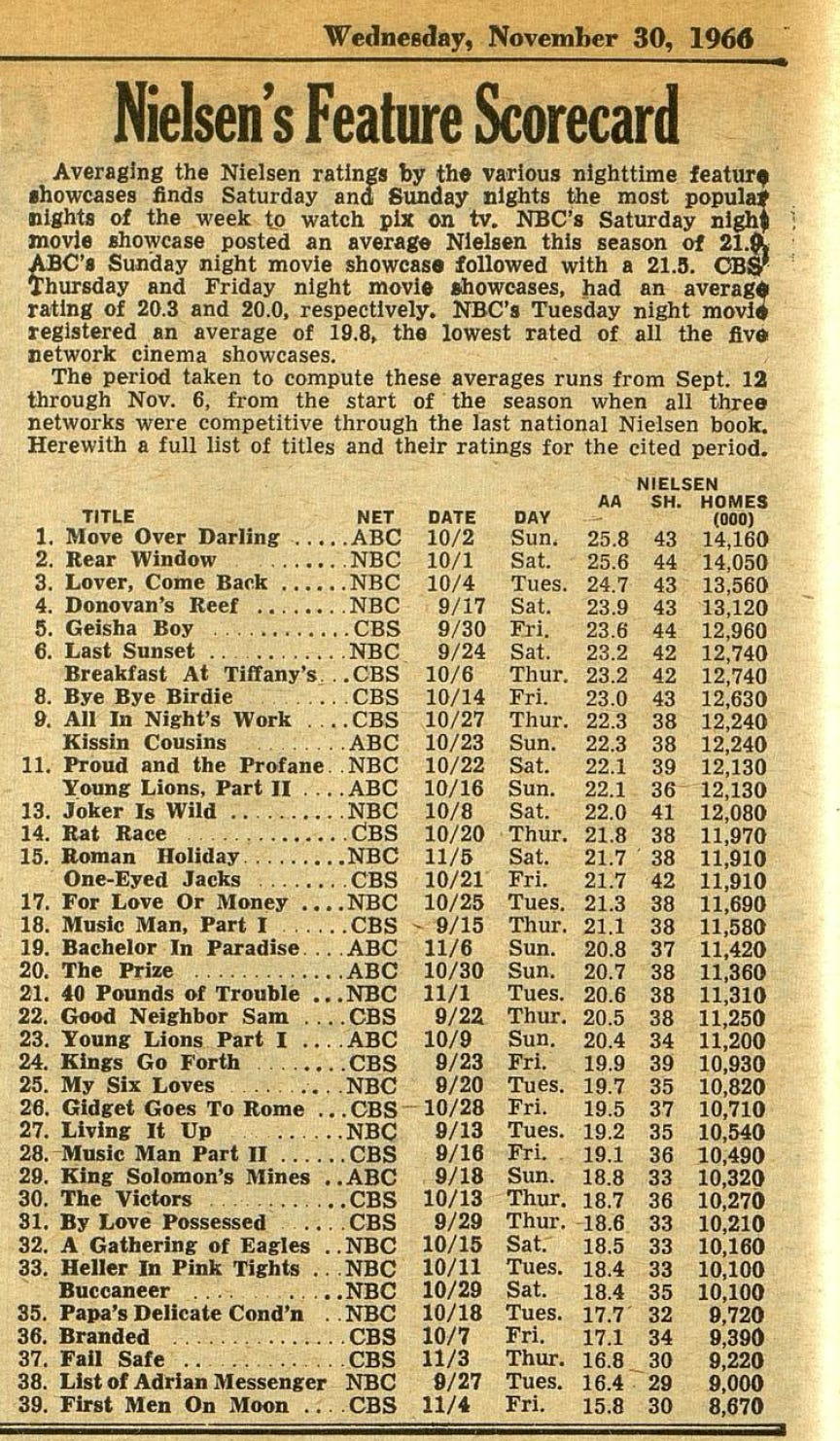
The chart above contains the top theatrical movies on Broadcast TV for 9/12/66-11/6/66. The top movie is a title no one knows today, Move Over Darling, starring Doris Day and James Garner. #2 is a classic, Alfred Hitchcock’s Rear Window, but most of the remaining twenty titles are also unknown today. Today’s Relevance: A similar list today for streaming or cable in 2026 would be dominated by franchises — family-friendly animation from Illumination and Disney, Harry Potter, Marvel, Star Wars, Lord Of The Rings, etc, along with a few stand-alone romcoms. In the 1960s, franchises were not a thing outside of perhaps James Bond, so the movies on TV were original and distinct stories, although some were based on books and novels.
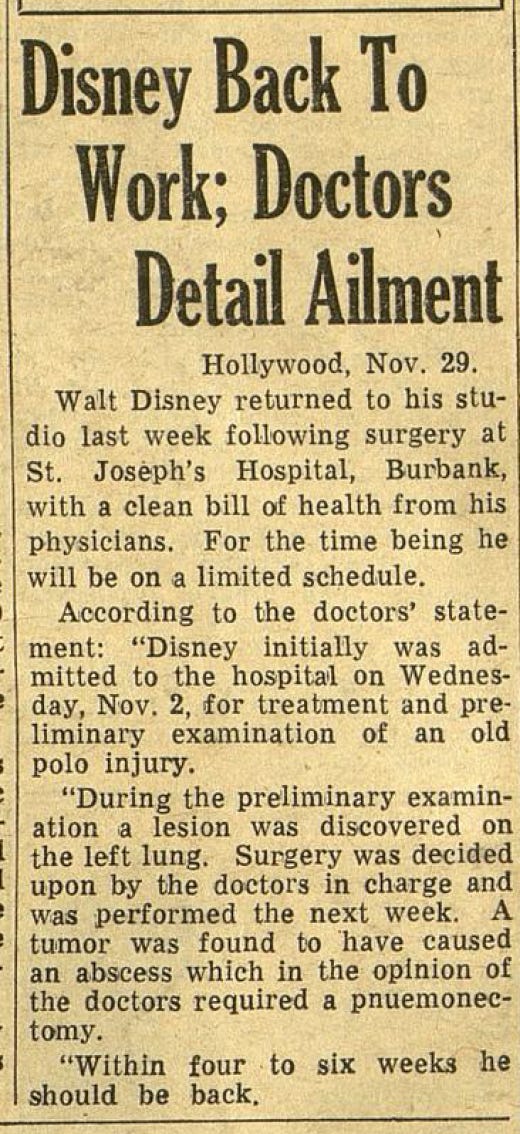
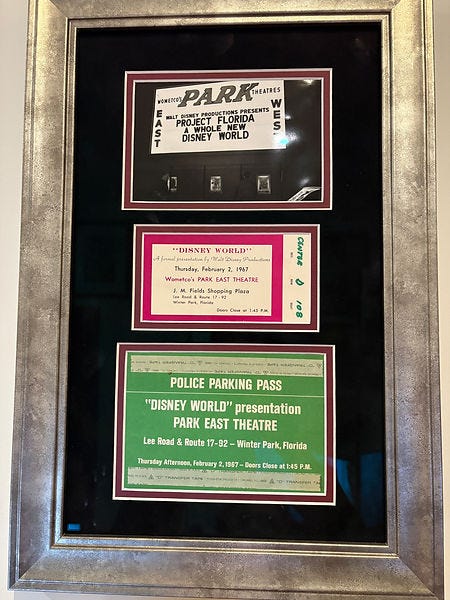
Walt Disney had surgery in November 1966, and this article notes that he was back at work with a clean bill of health a few weeks later. Just one month earlier, he had recorded the film that announced the creation of Walt Disney World and EPCOT, then planned to be an actual, working city. You can see it here.
Despite the generally upbeat nature of the article, Walt would die just 16 days later, and that film would not debut until a 2/2/1967 press presentation. From my Disney collection, here is a parking pass and ticket to that presentation, formerly owned by the lawyer who negotiated the purchase of most of the land in Orlando on which WDW sits.